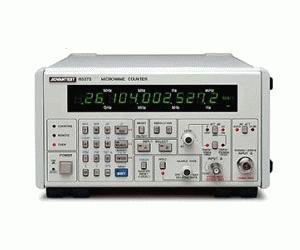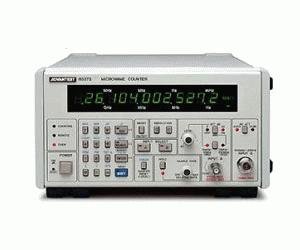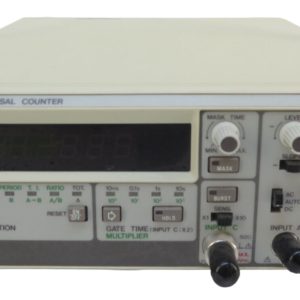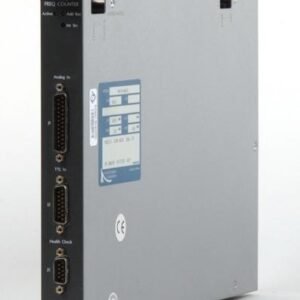

The Stanford Research Systems SR620 is a universal time interval and frequency counter engineered for precision timing measurements in laboratory, system integration, and engineering environments. It delivers single-shot time resolution of 25 ps rms and measures frequencies from 0.001 Hz to 1.3 GHz with up to 11 digits of resolution in a 1-second measurement window. Beyond basic frequency and timing, the instrument measures time intervals, pulse width, rise and fall time, period, phase, and event counts—making it suited for applications ranging from short-term jitter analysis in phase-locked loops to long-term drift monitoring of atomic clocks.
Technical Specifications
Time Interval Measurement
• Single-shot resolution: 25 ps rms
• Relative accuracy: 50 ps
• Absolute accuracy: 500 ps
• Maximum interval: ±1000 seconds
• Least Significant Digit: 4 ps
Frequency Measurement
• Range: 0.001 Hz to 1.3 GHz
• Resolution: Up to 11 digits in 1-second measurement; 1 nHz resolution available
Phase Measurement
• Resolution: 0.001°
Timebase
• Standard: 10.000 MHz with 1 × 10⁻⁶/year aging
• Optional Ovenized VCXO (Option 01): 10.000 MHz with 5 × 10⁻¹⁰/day aging
• External input: 5 MHz or 10 MHz
Statistical Analysis
• Automatic calculations: mean, standard deviation, Allan variance, minimum, maximum
• Configurable sample sizes: 1 to 1,000,000
Display and Output
• Graphical resolution: 250 (H) × 200 (V) pixels
• Display types: histograms, strip charts (mean values and jitter)
• Oscilloscope outputs: Two rear-panel X-Y analog outputs
• Hardcopy: Centronics port for dot-matrix printers; HP-GL compatible plotters via RS-232 or IEEE-488.2
• D/A outputs: Two rear-panel DAC outputs for mean and jitter voltages
– Key Features
• Dual-input simultaneous measurement capability
• Pulse width, rise time, and fall time analysis
• Event counting function
• Configurable measurement sample sizes from 1 to 1 million
• Real-time graphical display with histogram and trend analysis
• Voltage outputs for external instrumentation integration
– Interfaces and Integration
Remote control and configuration via GPIB (IEEE-488.2) interface enables integration into automated test environments and data acquisition systems.