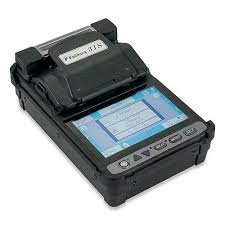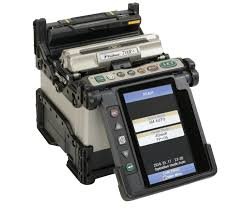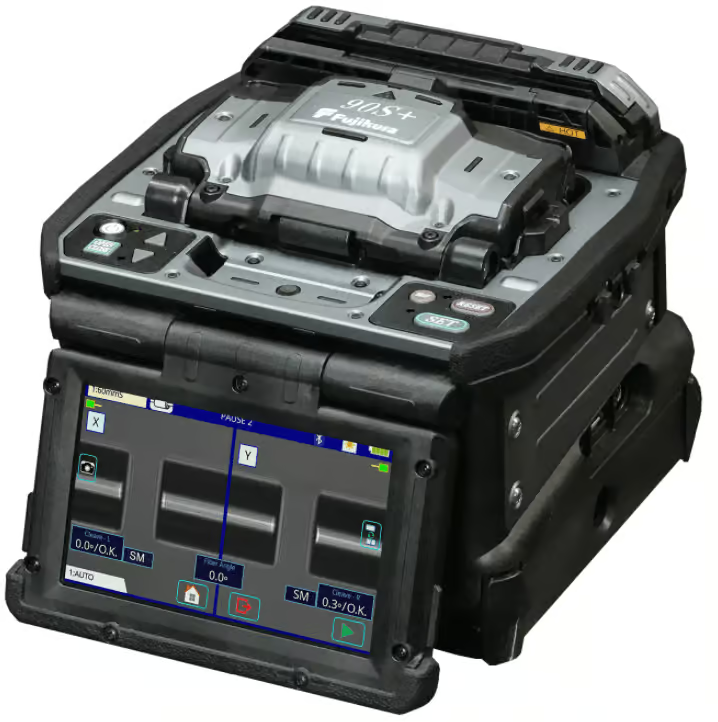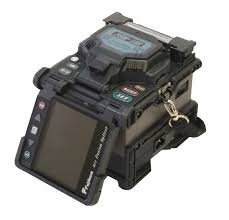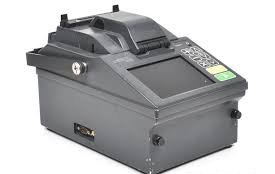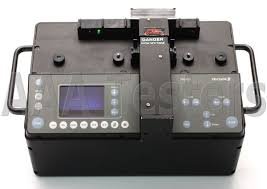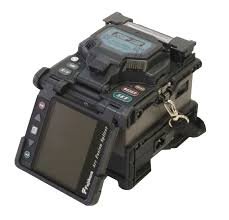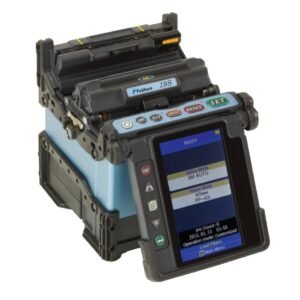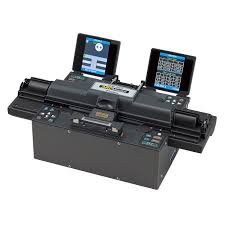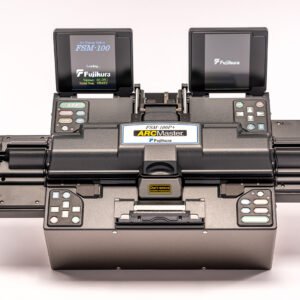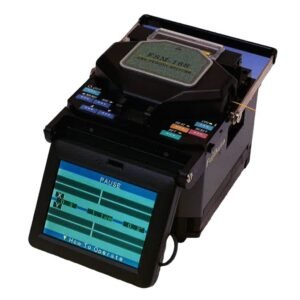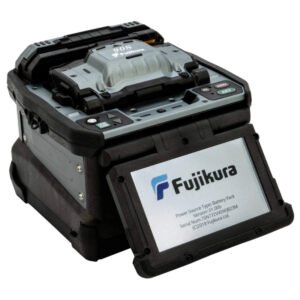

The Sumitomo Q101-M12 is a 12-fiber ribbon mass fusion splicer engineered for high-speed, high-precision splicing across single-mode, multi-mode, and specialty fiber types in telecommunications and data infrastructure networks. This Japanese-manufactured device delivers typical splice times under 70 seconds per 12-fiber ribbon with splice losses as low as 0.02 dB on multi-mode fiber, supported by 1500-splice electrode life and dual independent heat shrink ovens with auto pretension clamps.
Technical Specifications
Fiber Compatibility
• Single-Mode Fiber (SMF), Multi-Mode Fiber (MMF), Dispersion-Shifted Fiber (DSF), Non-Zero Dispersion-Shifted Fiber (NZ-DSF), Bend-Insensitive Fiber (BIF/UBIF)
• 1–12 fiber ribbon capacity
• Coating diameters: 0.25 mm, 0.50 mm, 0.90 mm
• Cladding diameter: 125 µm
• Cleave length: 10 mm
Splice Performance
• Typical splice time (12-fiber ribbon): Under 70 seconds
• Heater cycle time: 55 seconds
• Typical splice loss (identical fibers): SMF 0.05 dB, MMF 0.02 dB, NZ-DSF 0.08 dB
• Electrode life: 1500 splices
• Maximum splice programs: 200
• Maximum heating programs: 100
Power & Battery
• Input: 100–240 V AC, 50/60 Hz; 10–15 V DC
• Battery type: Li-ion
• Standard battery operation: 110 splice and heater cycles per full charge
• Recharge capability during AC-powered splicing
Environmental Durability
• Dust resistance: IP5x equivalent (8-hour dust chamber, 75 µm particles)
• Water resistance: IPx2
• Shock resistant
• Wind protection: 30 mph (15 m/s)
– Key Features
• High-resolution touchscreen with automatic display inversion
• Automatic functions: splice start, arc calibration, heater start, fiber identification, Auto Clamping Adjustment System (ACAS), live-time clamp force calibration
• Internal storage: 10,000 splice records; 64 images
• SD memory card port for unlimited data, video, audio, and software transfers
• USB 2.0 (mini-B) connectivity
• Remote maintenance via Internet interface
• RoHS compliant
– Typical Applications
Fiber ribbon splicing in metro and long-haul terrestrial networks, undersea cable systems, and hybrid fiber installations requiring high throughput with minimal loss.
– Compatibility & Integration
Standard SD card and USB 2.0 interfaces enable field data logging, splice program management, and remote diagnostics across distributed network deployment environments.