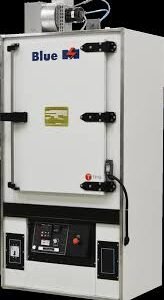

The Tenney T-Shock JR is a benchtop temperature shock chamber designed for rapid thermal cycling of small components and circuit boards. This compact two-zone system delivers efficient transitions between hot and cold extremes, with a 0.25 cubic feet chamber footprint ideal for space-constrained laboratories. The unit employs a cascade refrigeration system with dual semi-hermetic compressors and low-mass nichrome wire heating elements to achieve sharp temperature ramps. Temperature uniformity maintains ±1.0°C of setpoint across the test volume.
Technical Specifications
• Chamber Volume: 0.25 cubic feet (10.5″ W × 6″ H × 6.125″ D)
• Temperature Range: Hot chamber +40°C to +200°C; Cold chamber −65°C to +200°C
• Temperature Uniformity: ±1.0°C of setpoint
• Airflow: Vertical-down system
• Chamber Construction: 100% continuously welded stainless steel vapor-tight liners with fiberglass and polyurethane insulation; double-gasket doors
• Refrigeration: Cascade system with TEV control and two semi-hermetic compressors (3.5 HP + 0.5 HP or 3 HP + 0.5 HP configurations available)
• Heating Elements: Open-air, rapid-responding nichrome wire design
• Power Options: 208V 1-Phase 35A or 115V 1-Phase 60 Hz 18A
– Key Features
• Smart 1.2™ Control System with 7″ Windows-based PLC (800 MHz Cortex A9 processor, 4 GB SD card)
• Graphical touch-screen interface with high-resolution display
• PID chamber control with logic-based heating/cooling mode selection
• On-board data logging and graphical trend charting
• Communications: RS485, Ethernet, RS-232, IEEE 488
• RTD temperature sensors
• Configurable to near-infinite program steps
• Traveling 2-inch port for component access
• Available in horizontal or vertical orientations
• Alternate controllers: Watlow F4 or Series 942 options
– Typical Applications
Thermal shock testing of PCBs, small electronic assemblies, and discrete components requiring validated thermal cycling validation in quality assurance and reliability testing environments.
– Compatibility & Integration
The Smart 1.2™ controller provides 2 process inputs, 10 temperature control outputs, 6 event outputs, and per-channel alarm outputs. RS485 and Ethernet interfaces enable integration into automated test frameworks and data acquisition systems.