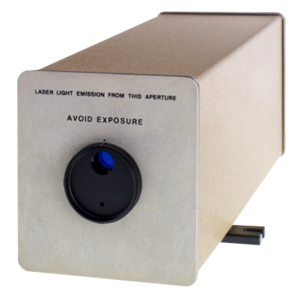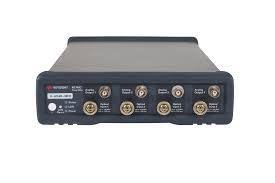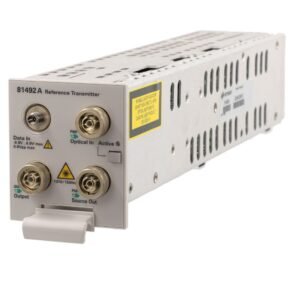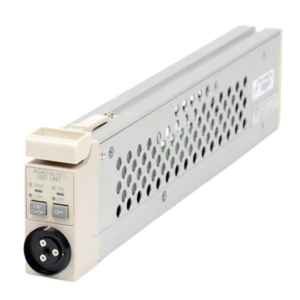
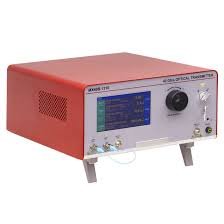

The ThorLabs MX40B-1310 is a 40 Gb/s digital reference transmitter engineered for high-speed optical communication system testing and component characterization. It features an internal 1310 nm fixed-wavelength laser paired with a limiting amplifier delivering 30 dB gain across a 20 GHz small-signal bandwidth. The instrument integrates a Mach-Zehnder intensity modulator with bias control and variable optical attenuation for precise output power management. Its limiting amplifier provides user-adjustable RF output swing from 3 V to 7 V, supporting Return-to-Zero (RZ), Non-Return-to-Zero (NRZ), and On-Off Keying (OOK) modulation formats across the full 40 Gb/s data rate.
Technical Specifications
• Maximum bit rate: 40 Gb/s
• Internal laser wavelength: 1310 nm (fixed)
• Small-signal bandwidth: 20 GHz
• Low-frequency cutoff: 100 kHz
• Limiting amplifier gain: 30 dB
• Amplifier RF output swing: 3 V to 7 V (user-adjustable)
• Optical output power: 13.5 dBm typical (22.39 mW)
• RF optical extinction ratio: 13 dB typical maximum
• Polarization extinction ratio: 18 dB
• Lambda/2 wave voltage: 5.5 V
• Electrical return loss: -10 dB typical
• Response time: 1 s
– Key Features
• Mach-Zehnder intensity modulator with integrated bias control
• Variable optical attenuator for power management
• Differential RF signal input
• Intuitive touchscreen interface with USB and RS-232 control
• External laser modulation capability (1250 nm to 1610 nm wavelength range) via loop-back configuration
• RoHS exempt
• One-year warranty; light source warranty limited to one year or specified operating hours
– Typical Applications
• High-speed optical component and system characterization
• 40 Gb/s digital signal generation for test and validation
• Modulation format validation (RZ, NRZ, OOK)
• Optical communication system testing at 1310 nm
– Compatibility & Integration
The MX40B-1310 accepts external laser sources within the 1250 nm to 1610 nm range through external loop-back configuration, enabling customized wavelength implementations while retaining the unit’s modulation and amplification capabilities.