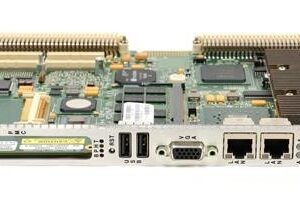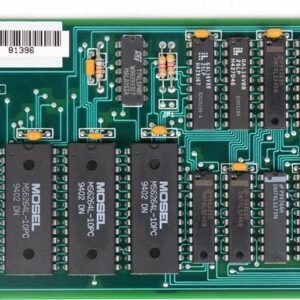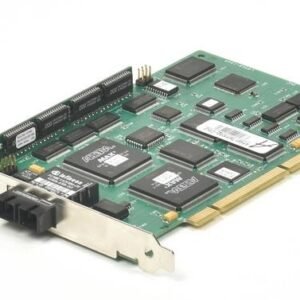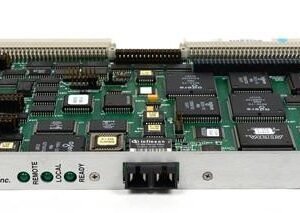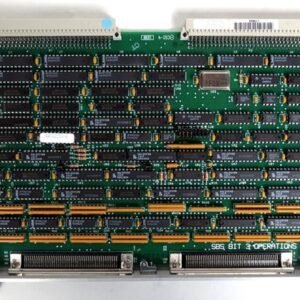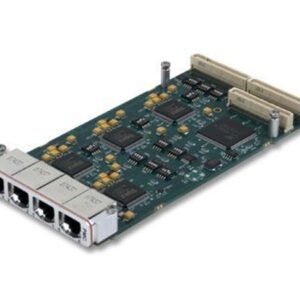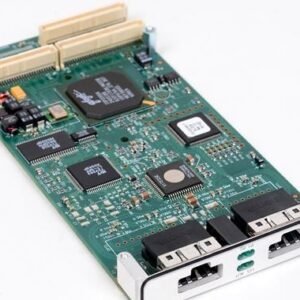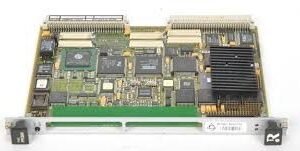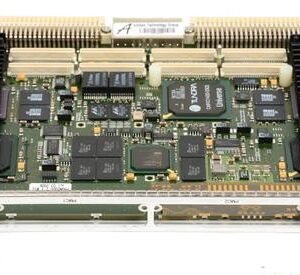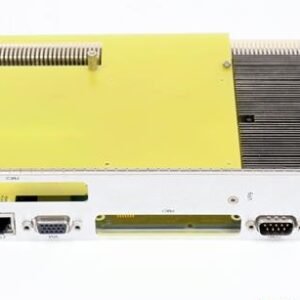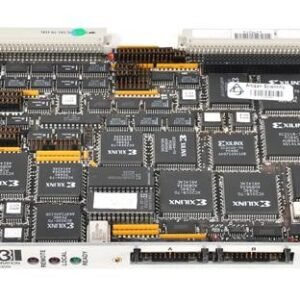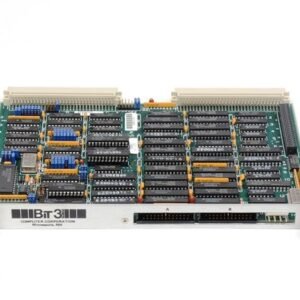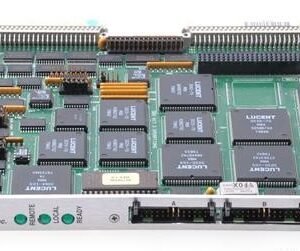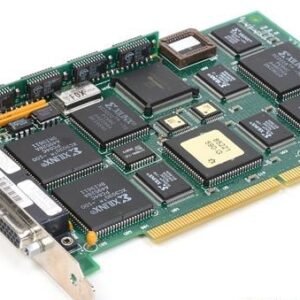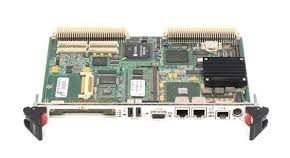
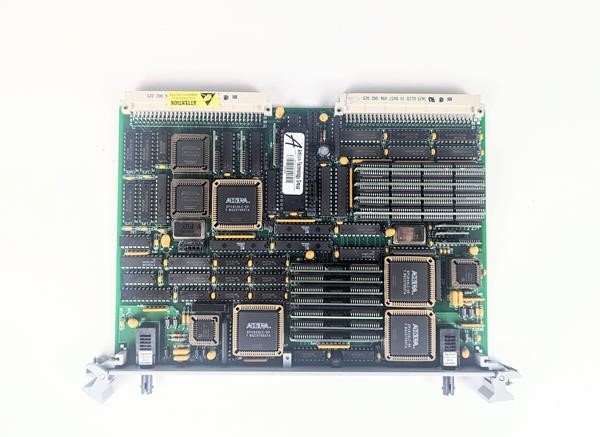

The Abaco Systems / VMIC VMIVME-5576-210 is a fiber-optic reflective memory (RFM) board for VMEbus systems that enables transparent, real-time data sharing across networks of up to 256 nodes. Data written to memory locations on any node automatically replicates to all other nodes without CPU intervention or I/O overhead. Operating at 170 Mbaud over multimode fiber-optic media with 1,300 nm transmitters, the module delivers deterministic, low-latency data exchange ideal for industrial and military applications requiring synchronized distributed processing.
Technical Specifications
Data Transfer and Network Architecture
• Multidrop, daisy-chain ring topology supporting 256 independent nodes
• Data transfer rate: 6.2 Mbytes/s per node (standard mode); 3.2 Mbytes/s per node (redundant transfer mode)
• Fiber-optic transmission at 170 Mbaud, 1,300 nm wavelength
• Software-transparent data replication—no polling or processor intervention required
• Deterministic latency with repeatable performance
• Redundant transmission mode with built-in error detection
• Configurable on-board Transmit/Receive FIFOs: 512-word or 4k-word options
Memory Configuration
• On-board SRAM: 256 KB, 512 KB, or 1 MB options
• Memory access: A24:A32:D32:D16:D8
• Addressable boundaries match selected capacity (256 KB, 512 KB, or 1 MB)
• Fast local SRAM read access
Interrupt Capabilities
• Any node generates interrupts to any or all other nodes
• Interrupts follow data transfer to ensure reception before acknowledgment
• Three user-definable interrupt levels and vectors
• Supports process synchronization across distributed systems
Physical
• Form factor: Single 6U VMEbus board
• Dimensions: 233.35 mm H × 160 mm D
• Weight: approximately 0.5–0.7 kg
• Fiber-optic connectors: ST-style bayonet (multimode, 2.5 mm ferrule)
– Key Features
• Hardware-transparent data synchronization across 256-node networks
• Fiber-optic isolation for noise-immune operation in harsh environments
• Dual-mode operation balances throughput and redundancy
• Flexible memory sizing and addressable boundaries
• FIFO buffering optimizes CPU and VMEbus utilization
– Typical Applications
• Distributed real-time data acquisition systems
• Military and aerospace command-and-control networks
• Industrial process synchronization requiring deterministic timing
• Multi-node sensor fusion and telemetry systems
– Compatibility & Integration
Compliant with VMEbus architecture. Operates in multidrop ring configurations supporting heterogeneous node counts up to 256 systems.