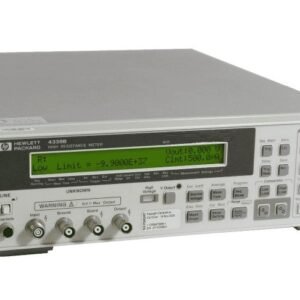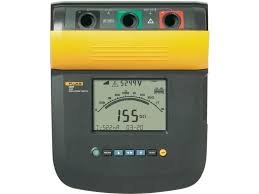
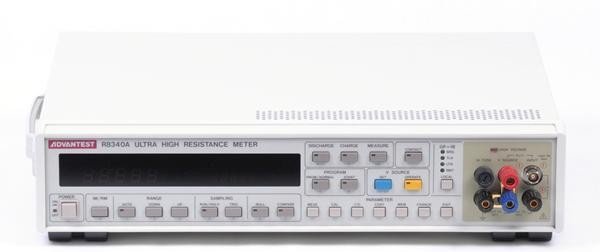

The Advantest R8340 Ultra High Resistance Meter is a precision instrument engineered for measuring extremely high resistance values and micro currents across insulation testing and material characterization applications. The meter combines an input amplifier gain switching type I-V converter, high-speed sampling A/D converter, and low-noise, high-response voltage generator to deliver both speed and measurement accuracy across an exceptionally wide dynamic range.
Technical Specifications
• Current measurement: 10 fA to 19.999 mA
• Resistance measurement: 10 Ω to 3 × 10^16 Ω
• DC voltage source: 0.000 V to 1000.0 V, continuously variable
• Floating measurement capability: Up to 550 Vpeak (R8340 model)
• Measurement speed: Up to 100 samples per second with high-speed charge/discharge capability
• Data storage: Up to 1000 measurement records
• Power supply options: 110 VAC or 230 VAC configurations with internal jumper selection
– Key Features
• Floating measurements up to 550 Vpeak enable testing when one end of a coaxial cable is grounded
• Sequence Program Function stores and recalls measurement conditions; includes standard JIS C5102 measurement procedures
• Contact Check Function simplifies stable, precise measurements for routine testing
• Automatic Range Level Function delivers fast response measurements optimized for required digit resolution in current measurements
• Auditory alerts via buzzer signal COMPARE results (Hi/Lo), program completion, and system abnormalities
– Typical Applications
• Testing and inspection of electric insulation materials including synthetic resin and rubber
• Measurement of switches, connectors, and capacitors
• Micro current measurement: ion current and leak current characterization
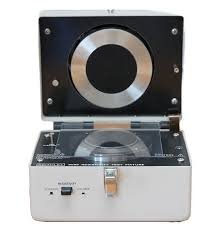
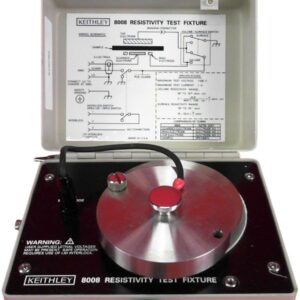
• Surface and volume resistivity measurements with optional accessories (R12704, R172708)
– Compatibility & Integration
• GPIB interface conforming to IEEE 488-1978 standard
• Handler interface for integration with automatic test fixtures and handlers
• D/A output, BCD output, and trigger signal control via GPIB