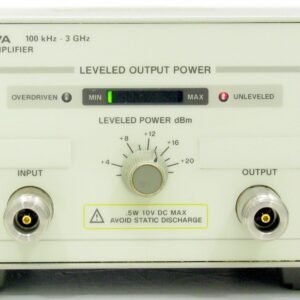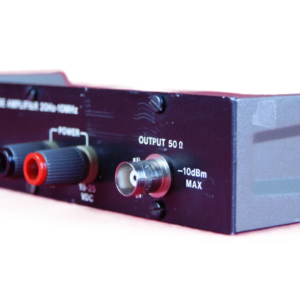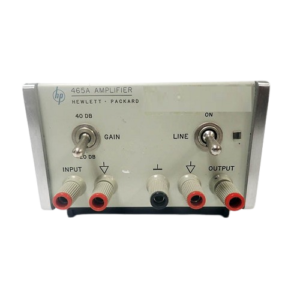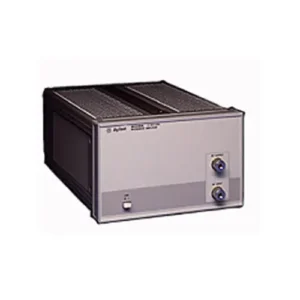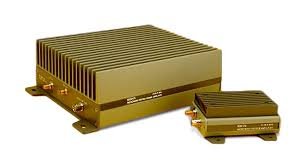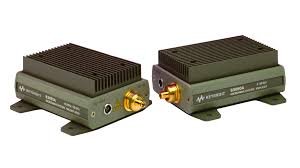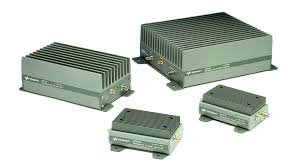
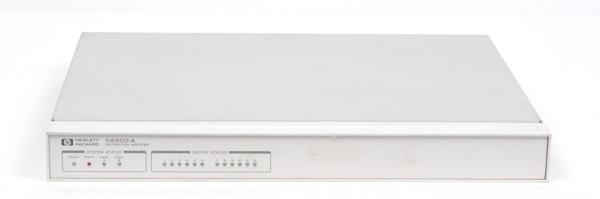

The Agilent/HP/Symmetricom 58502A is a broadband distribution amplifier that accepts two independent frequency standard inputs and distributes them across 12 isolated output ports. Engineered for manufacturing, R&D, and standards laboratory environments, it supplies low-noise sinusoidal signals derived from cesium, rubidium, quartz, and GPS frequency standards. The instrument maintains signal integrity through exceptional port-to-port isolation and low single-sideband phase noise across its 0.1 MHz to 10 MHz operating range.
Technical Specifications
Inputs
• Two BNC female connectors (A and B)
• 0.1 MHz to 10 MHz frequency range
• 50 Ω nominal impedance, <1.5 SWR
• +7 dBm to +15 dBm amplitude requirement
Outputs
• Twelve BNC female connectors (1–12)
• 0.1 MHz to 10 MHz frequency range
• +13 dBm ±1 dB/−3 dB into 50 Ω
• Harmonics: ≤32 dBc standard; ≤20 dBc with Option 010
• Spurious: ≤110 dBc standard; ≤80 dBc with Option 010
• Port-to-port isolation: ≤100 dBc typical
Phase Noise (Single Sideband, 1 Hz bandwidth)
• 100 Hz offset: ≤127 dBc/Hz
• 1 kHz offset: ≤142 dBc/Hz
• 10 kHz offset: ≤148 dBc/Hz
– Key Features
• Automatic input switching when primary source fails or amplitude drops significantly
• TTL-compatible alarm inputs from Symmetricom 58503A/B GPS receivers and 5071A primary frequency standards
• Automatic backup source selection upon active alarm detection
• Alarm outputs with open-collector configuration, 10 kΩ pull-up to 5 Vdc; TTL High = normal, TTL Low = alarm state
• Optional 10 MHz oven-controlled quartz crystal oscillator (Option 010) replaces Input B; enables standalone operation or automatic failover with frequency stability of 6 × 10⁻⁹ (0°C to +55°C) and aging rates of 5 × 10⁻¹⁰/day and 1 × 10⁻⁷/year
– Typical Applications
Frequency signal distribution in metrology labs, atomic clock networks, precision timing systems, and multi-channel RF/microwave test environments requiring low-noise reference sources.
– Compatibility & Integration
Works with Symmetricom 58503A/B GPS Time and Frequency Reference Receivers and 5071A Primary Frequency Standards through dedicated alarm input/output interfaces.