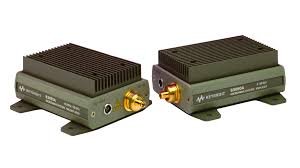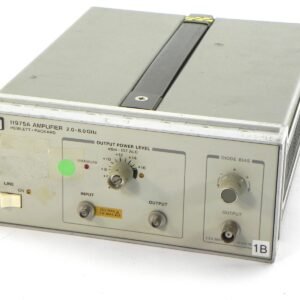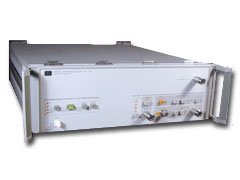
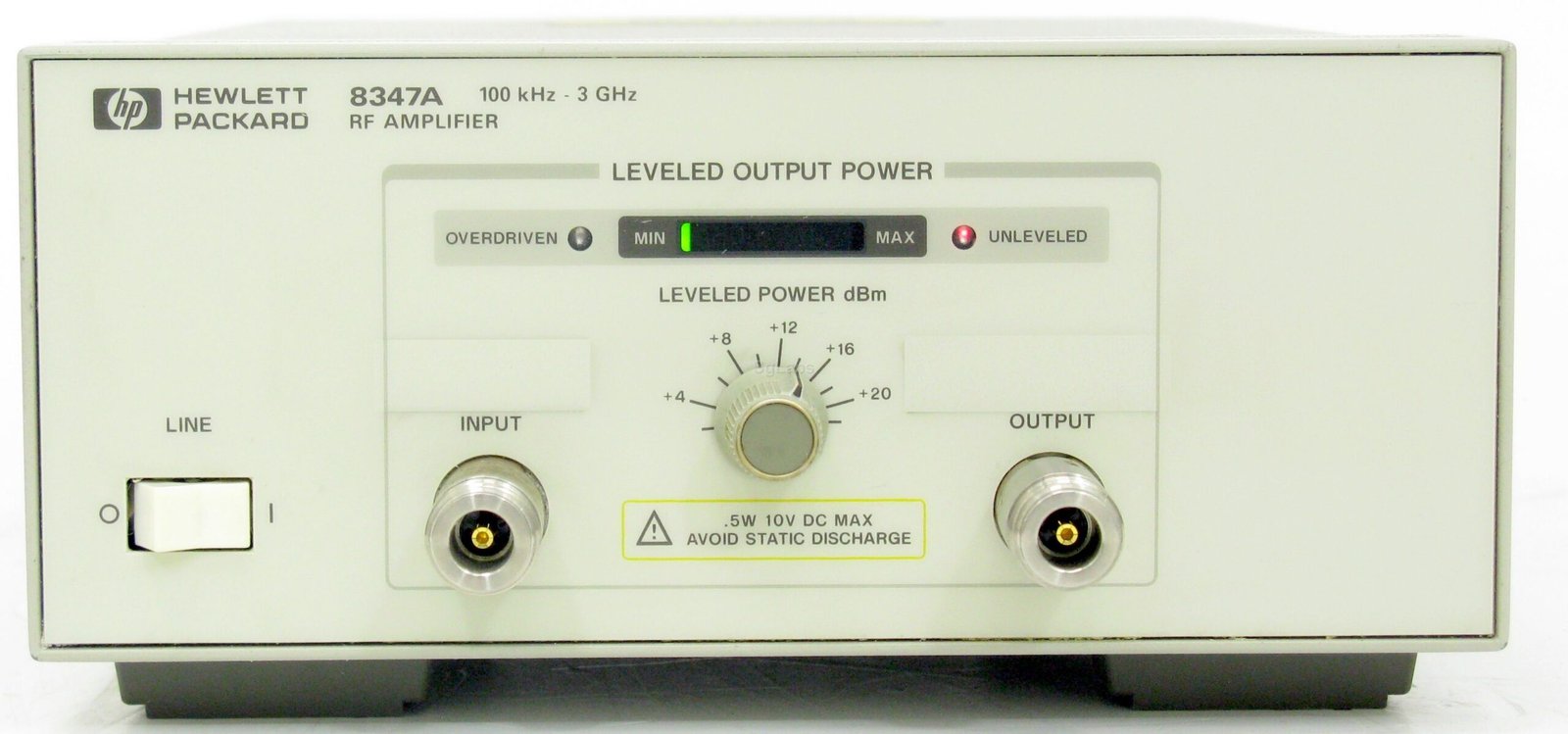

The Keysight 8347A is a broadband RF amplifier engineered for instrumentation and test applications across 100 kHz to 3 GHz. It delivers minimum gain of 25 dB with leveled output power spanning +2 dBm to +20 dBm, addressing signal losses in network analysis, receiver characterization, and high-power device drive scenarios. An internal leveling loop (ALC) reduces mismatch effects and maintains output flatness within ±1.5 dB across the operating band, enabling repeatable measurements in demanding test environments.
Technical Specifications
Frequency & Power
• Frequency range: 100 kHz to 3 GHz
• Gain: ≥25 dB (typical, 20–30°C)
• Maximum leveled output power: ≥+20 dBm
• Output leveling range (>300 kHz): +2 dBm to +20 dBm
• 1 dB compression point: +22 dBm (nominal)
• Third-order intercept: +30 dBm (nominal)
• Power flatness (internally-leveled, ±300 kHz): ±1.5 dB
Distortion & Noise
• Harmonic distortion at +20 dBm (ALC Off): ≤–25 dBc
• Harmonic distortion at +20 dBm (ALC On): ≤–20 dBc
• Noise figure (10 MHz to 3 GHz): <15 dB (typical)
• Noise figure (below 10 MHz): <20 dB (typical)
Impedance & Return Loss
• RF impedance: 50 ohms nominal
• Input VSWR: 60 dB (typical)
Input & Power
• Maximum input for minimum internally-leveled output: –14 dBm
• Maximum continuous input power: +27 dBm
• AC supply: 100, 120, 200, or 240 V (±10%), 50–400 Hz
• Power consumption: 45 VA maximum
– Key Features
• Type N female RF connectors (input and output)
• Internal automatic level control for output power stabilization
• Compact benchtop form factor: 213 mm W × 102 mm H × 297–298 mm D
• Net weight: 3.5–4 kg; shipping weight: 5 kg
– Typical Applications
• Network analyzer drive and receiver enhancement
• Low-level signal amplification in receiver front-end testing
• High-power device characterization and validation
• Wideband instrumentation requiring flat gain across multiple octaves
– Compatibility & Integration
Standard 50-ohm interface with Type N connectors supports integration into existing RF test systems. Leveled output accommodates mismatched loads while maintaining measurement accuracy.