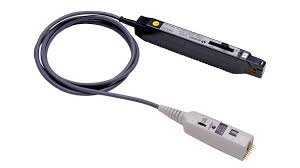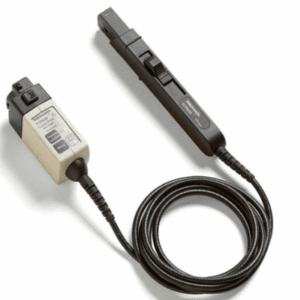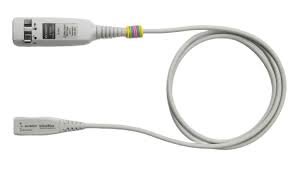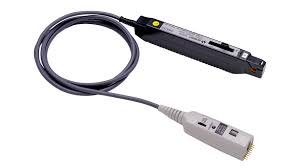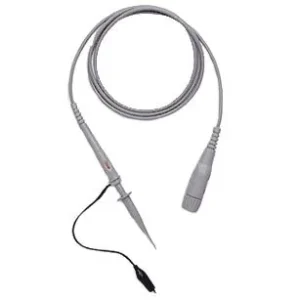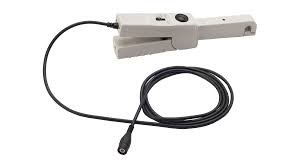

The Keysight 11588A is a high-performance active probe engineered for high-speed signal acquisition and detailed waveform analysis on complex circuits. With 4 GHz bandwidth and 88 ps rise time, it enables precise characterization of fast edges while maintaining low loading effects on the device under test. The probe features a non-resonant 100 kΩ input impedance (0.8 pF) and supports ±15 V offset with up to 5 V peak-to-peak dynamic range. Its 10:1 attenuation and maximum 40 V input voltage rating accommodate a wide range of measurement scenarios. The 11588A integrates with Keysight’s AutoProbe interface for automatic oscilloscope configuration and includes resistive damping accessories that minimize probe parasitics and DUT loading effects.
Technical Specifications
• Bandwidth: 4 GHz (with 110 Ω resistive signal pin and solderable ground socket)
• Rise Time: 88 ps
• Input Impedance: 100 kΩ, 0.8 pF, non-resonant
• Dynamic Range: ±15 V offset, 5 V peak-to-peak; >12 Vpp for edges >3 ns
• Attenuation: 10:1
• Maximum Input Voltage: 40 V
• Alternate Configuration: 3.5 GHz bandwidth / 100 ps rise time with 130 Ω resistive signal pin and ground blade assembly
– Key Features
• Interchangeable signal pins optimize bandwidth and rise time for specific measurement requirements
• Resistive damping accessories suppress resonance and reduce DUT impact
• AutoProbe interface simplifies probe-to-oscilloscope handshake
• Compact probe geometry accesses confined measurement points on densely populated boards
– Typical Applications
• High-frequency analog and digital waveform characterization
• Multi-gigahertz signal integrity analysis
• Board-level debugging in space-constrained environments
– Compatibility & Integration
• Oscilloscope Series: Keysight Infiniium and InfiniiVision 5000, 6000, 7000 Series (6000 Series 100 MHz models excluded)
• Interface: AutoProbe compatible
• Status: Obsolete as of June 1, 2014; end of support September 1, 2019. Keysight recommends N2750A-52A InfiniiMode differential probes or N2795A/96A single-ended active probes as alternatives.