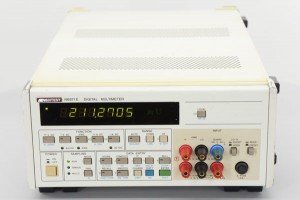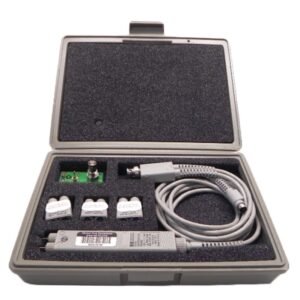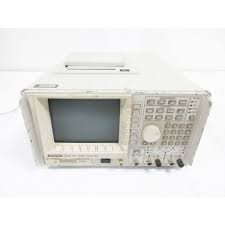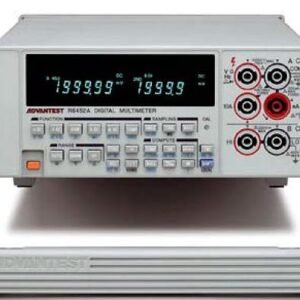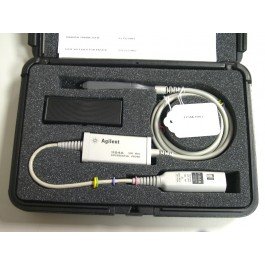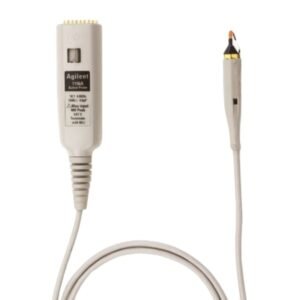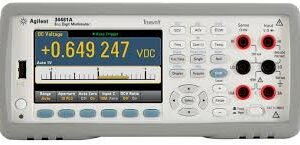
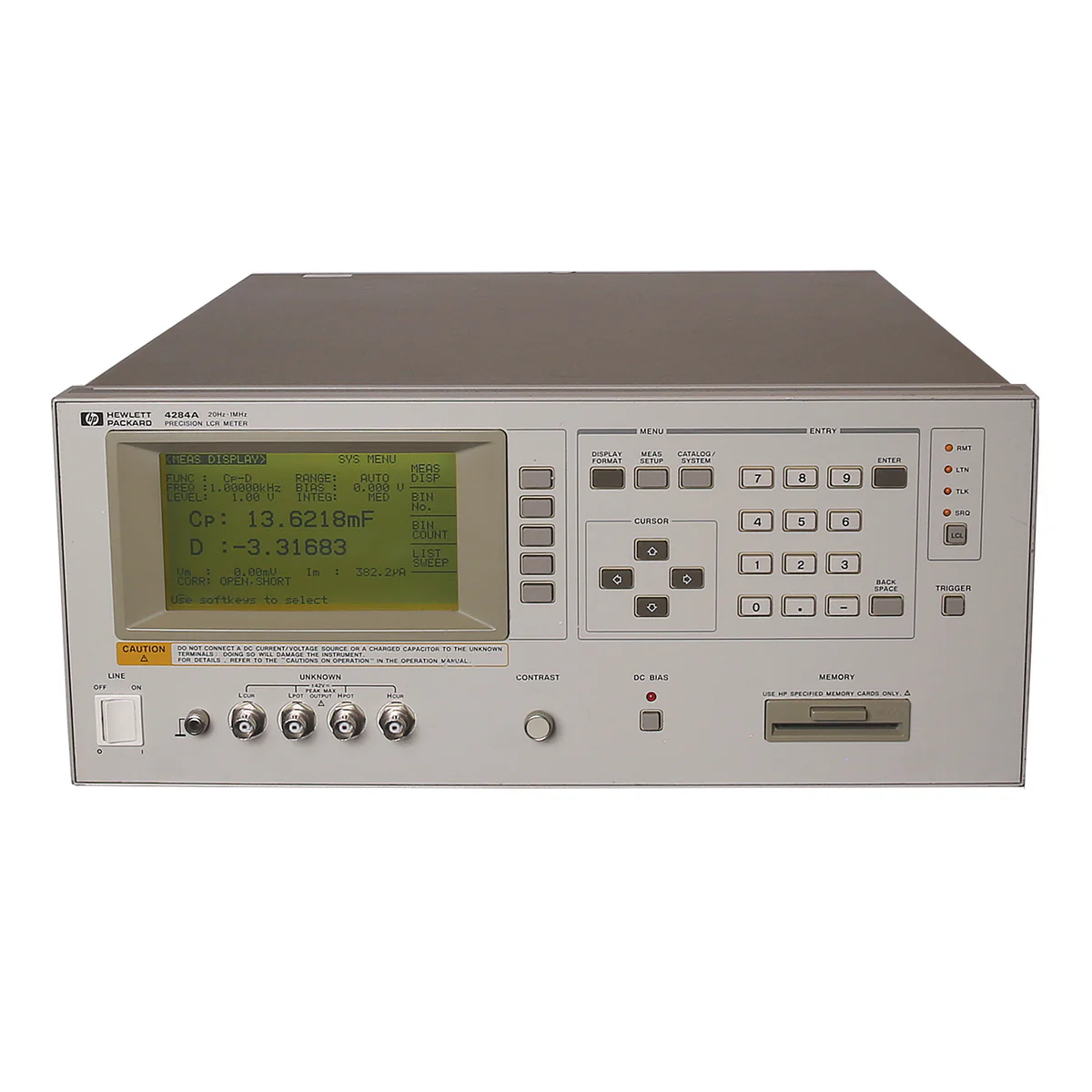

The Agilent/HP 4284A Precision LCR Meter delivers high-accuracy component and material characterization across a broad frequency spectrum. Built for research, production testing, quality assurance, and incoming inspection, the 4284A combines measurement versatility with cost-effective operation and compliance with IEC/MIL test standards.
Technical Specifications
The 4284A measures impedance (|Z|), admittance (|Y|), inductance (L), capacitance (C), resistance (R), conductance (G), dissipation factor (D), quality factor (Q), equivalent series resistance (Rs), parallel resistance (Rp), reactance (X), susceptance (B), and phase angle (θ). Measurement combinations and deviation calculations from programmable reference values are supported.
Frequency coverage spans 20 Hz to 1 MHz with 8610 selectable frequencies at ±0.01% accuracy. Test signal modes include Normal (program-selected voltage or current) and Constant (maintained voltage or current independent of DUT impedance changes).
Voltage ranges from 5 mVrms to 2 Vrms (Normal Mode) with ±(3% of reading + 0.5 mVrms) accuracy in Constant Mode and ±(10% + 1 mVrms) in Non-constant Mode. Current ranges from 50 µArms to 20 mArms (Normal Mode) with ±(3% of reading + 5 µArms) accuracy in Constant Mode and ±(10% + 10 µArms) in Non-constant Mode. Option 001 extends capabilities to 20 Vrms / 0.2 Arms with variable ±40 Vdc bias.
Basic measurement accuracy is 0.05%; at 1 MHz, capacitance achieves 0.05% and dissipation factor 0.0005. L, C, X, and B accuracies apply when measured D ≤ 0.1.
– Key Features
• Four-terminal pair measurement terminals
• Parallel and Series equivalent measurement circuits
• Auto and Manual ranging (Hold/Up/Down)
• Internal, External, BUS (GPIB), and Manual triggering
• Programmable delay from trigger to measurement: 0 to 60.000 seconds in 1 ms steps
• Short, Medium, and Long integration time modes
• Averaging from 1 to 256 measurements
• Standard test cable lengths: 0 m and 1 m selectable
• Option 4284A-006 adds 2 m and 4 m cable length selection
– Typical Applications
Research and development, production testing, quality assurance, incoming component inspection, and material characterization.
– Compatibility & Integration
GPIB (BUS) programmability enables integration into automated test systems.