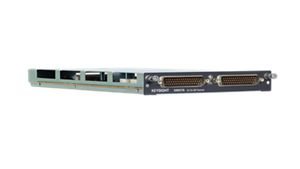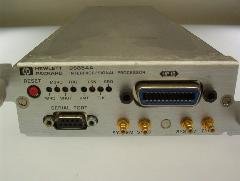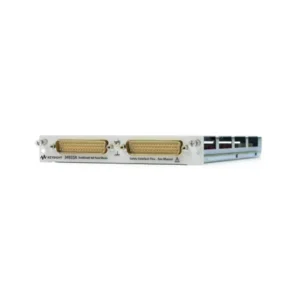

The Agilent/Keysight 5087A is a modular distribution amplifier that conditions and distributes precision frequency reference signals with minimal distortion and crosstalk. It accepts inputs at 10 MHz, 5 MHz, 1 MHz, and 0.1 MHz, distributing each to up to 12 independently configurable output channels. The unit delivers output voltages adjustable from 0 to 3 Vrms per channel, with channel-to-channel crosstalk of -60 dB and exceptional load isolation—any channel load produces less than 0.1% amplitude variation and phase shifts below 0.1 ns at 5 and 10 MHz.
Technical Specifications
• Input Channels: 3 (configurable)
• Output Channels: Up to 12 per input (selectable)
• Supported Input Frequencies: 10 MHz, 5 MHz, 1 MHz, 0.1 MHz
• Output Voltage Range: 0–3 Vrms per channel (individually adjustable)
• Channel-to-Channel Crosstalk: -60 dB
• Load Isolation (amplitude): <0.1%
• Load Isolation (phase): <0.1 ns (5 & 10 MHz); <0.5 ns (1 MHz); 60 dB across all outputs except 10 MHz (>50 dB on 10 MHz output) for 1 V signals up to 50 MHz
• AC Power: 115 or 230 Vac ±10%, 48–440 Hz, 20 VA maximum
• DC Backup: 22–30 Vdc, 600 mA maximum
• Line Voltage Immunity: No measurable effect on output amplitude or phase
– Key Features
• Tuned output amplifiers provide clean signals and high channel isolation
• Shielded input and output amplifier stages minimize noise and crosstalk
• Front panel 16-position meter monitors input lines, output lines, and power supply voltage
• All connectors and fuses on rear panel
• Dimensions: 88 mm H × 425 mm W × 286 mm D; 7 kg (typical)
• Environmental ratings: 95% humidity (40 °C), altitude to 30,000 ft, MIL-STD-167 vibration, MIL-E-5400 shock (30 G), MIL-STD-461A EMC compliance
– Typical Applications
• Frequency standard distribution in metrology and timekeeping systems
• Multi-channel signal distribution for atomic and crystal oscillator networks
• Precision reference conditioning in standards laboratories and test systems
– Compatibility & Integration
The 5087A mainframe supports modular input and output configurations, allowing tailored distribution architectures for specific system requirements.