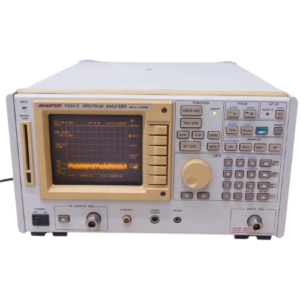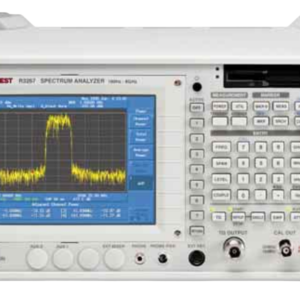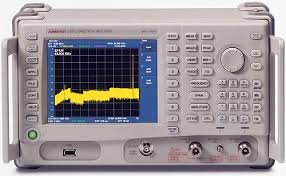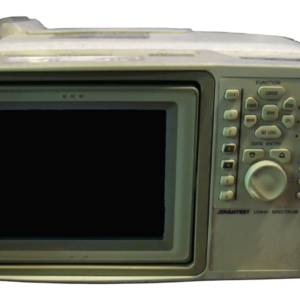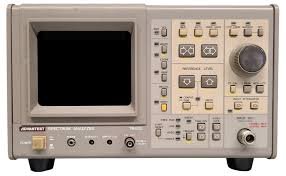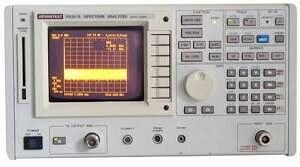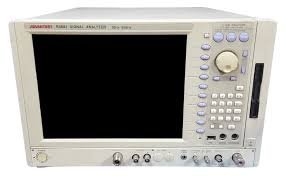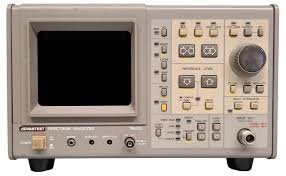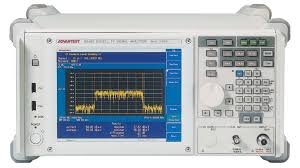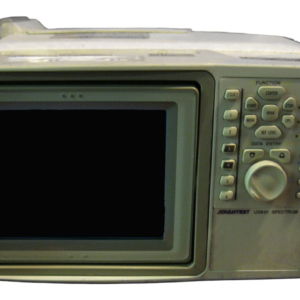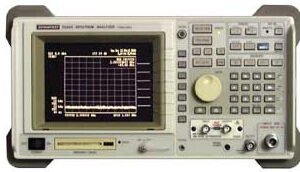
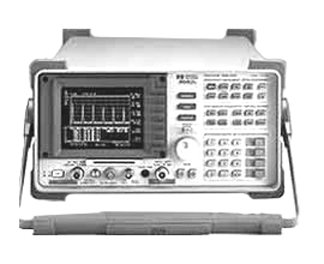

The Agilent/Keysight 8592D is a spectrum analyzer for RF and microwave signal characterization across 9 kHz to 22 GHz, expandable to 26.5 GHz with optional modules. It delivers amplitude measurement from -114 dBm to +30 dBm with displayable average noise levels between -112 dBm and -92 dBm, making it suitable for precision RF diagnostics in defense, aerospace, telecommunications, and component validation.
Technical Specifications
Frequency Performance
• Operating range: 9 kHz to 22 GHz (standard); up to 26.5 GHz with Option 026 or 027
• Five harmonic bands spanning 9 kHz to 26.5 GHz across local oscillator multiples
• Frequency span: 0 Hz zero span to 19.25 GHz
• Sweep time range: 20 ms to 100 s with ±3% accuracy
• Frequency reference aging: ±2 × 10⁻⁶/year; temperature stability: ±5 × 10⁻⁶
• Initial frequency accuracy: ±0.5 × 10⁻⁶
• Comb generator: 100 MHz fundamental with ±0.007% accuracy
Amplitude Characteristics
• Dynamic range: -114 dBm to +30 dBm
• DANL: -112 dBm to -92 dBm
• Maximum safe input: +30 dBm continuous (50 Ω); +50 dBm peak pulse (<10 µs, <1% duty cycle)
• Gain compression: ≤0.5 dB at -10 dBm input mixer power
• Reference level resolution: 0.01 dB (log) or 0.12% (linear)
• Reference level accuracy: ±0.3 dB @ -20 dBm
• Display scale: 0.1 to 20 dB/division across 8 divisions
• Marker readout: 0.05 dB (log) or 0.5% (linear) resolution
Display & Readout
• Scale units: dBm, dBmV, dB, µV, V, W
• Log incremental accuracy: ±0.4 dB/4 dB from 0 to -60 dB reference
• Marker frequency readout: ±[(5 × N) MHz + 0.01% of center frequency + 2% of frequency span]
– Key Features
• Multiple sweep trigger modes: free run, single, line, video, external
• Customizable measurement options for application-specific requirements
• Dual-input compatibility with 50 Ω or 75 Ω (Option 001)
• Harmonic mixing architecture supporting five overlapping frequency bands
– Typical Applications
• Component characterization and RF device testing
• Spectrum monitoring and signal identification
• Transmitter and receiver validation
• Interference detection and analysis
• Noise figure and gain measurements across microwave bands