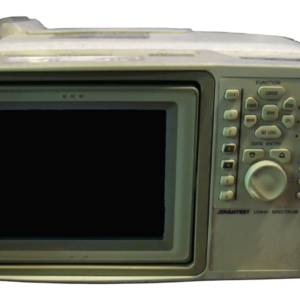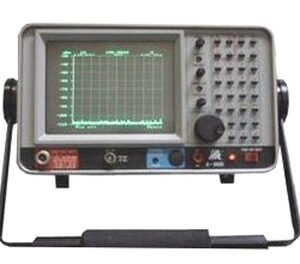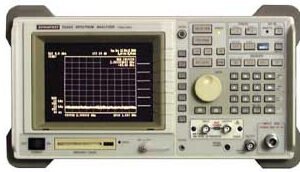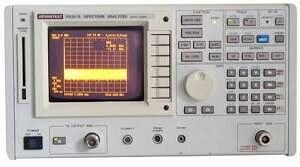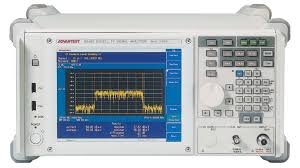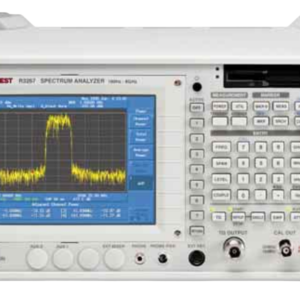
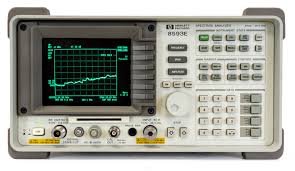

The Agilent/Keysight 8593E is a portable spectrum analyzer spanning 9 kHz to 22 GHz, engineered for signal monitoring, component testing, and EMC applications. It delivers measured noise floors as low as -155 dBm and amplitude accuracy of ±1 dB across a -120 dBm to +30 dBm range. The instrument supports ten independent markers, multiple detector types, and advanced measurements including C/N ratio, adjacent channel power, and third-order intermodulation analysis.
Technical Specifications
Frequency Domain
• Frequency range: 9 kHz to 22 GHz
• Resolution bandwidth: 1 Hz to 3 MHz (1-3-10 sequence)
• Video bandwidth: 1 Hz to 3 MHz (1-3-10 sequence)
• Frequency span: 10 Hz to 22 GHz
• Frequency reference accuracy: ±5 ppm
Amplitude Domain
• Displayed average noise level: -138 dBm to -155 dBm (typical)
• Amplitude range: -120 dBm to +30 dBm
• Amplitude accuracy: ±1 dB (typical)
• Reference level: -80 dBm to +30 dBm
• Scale units: dBm, dBmV, dBµV, V, mV, µV
• Detectors: Peak, Sample, Negative Peak, RMS, Average
• Trace functions: Max Hold, Min Hold, Average, Normal, Blank
Sweep and Control
• Sweep time: 50 ms to 1000 s
• Trigger modes: Free Run, External, Video, Line
Power
• Input: 90–132 VAC or 195–264 VAC, 47–63 Hz
• Consumption: Typically under 200 VA
– Key Features
• Ten independent markers with delta marker functionality
• C/N and adjacent channel power measurements
• Third-order intermodulation (TOI) analysis
• Channel power and bandwidth measurements
• AM/FM demodulation (Option 011)
• High-resolution tracking generator to 1.8 GHz (Option 008)
• High-speed sweep capability (Option 009)
• 13 dB attenuator option (Option 021)
– Typical Applications
• Signal monitoring and spectral analysis
• Component and subsystem characterization
• Electromagnetic compatibility testing
• Scalar measurements (Option 010)
– Compatibility & Integration
HP-IB (IEEE 488) interface enables integration with automated test equipment and data acquisition systems. Type N RF input (50 Ohm) accommodates standard RF and microwave components. External reference input accepts 1–10 MHz signals; external triggering via BNC. Analog video output available.