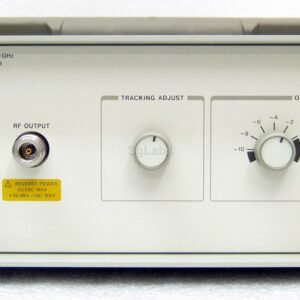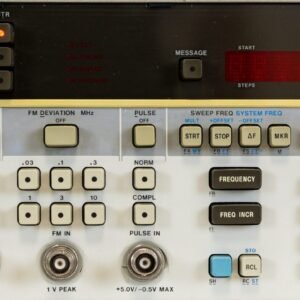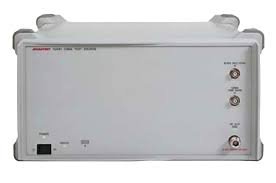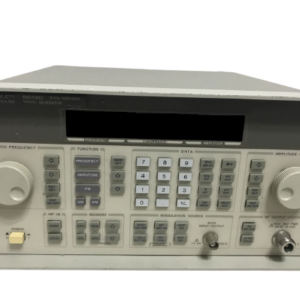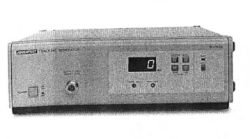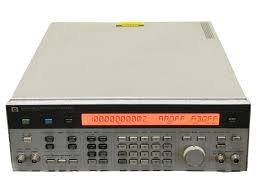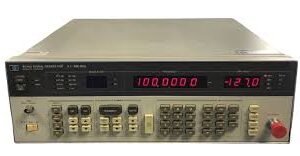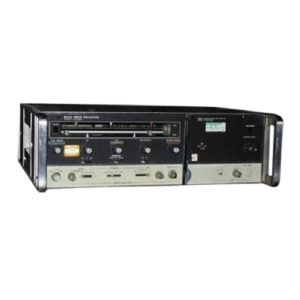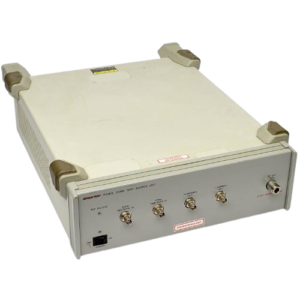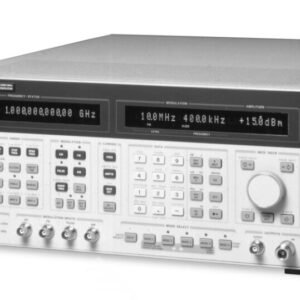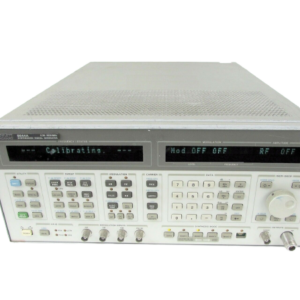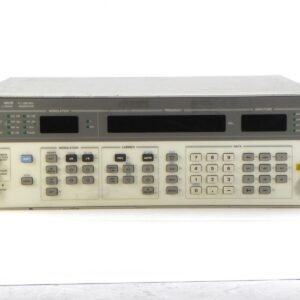
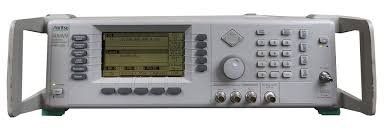

The Anritsu 69247A Synthesized Signal Generator delivers precise RF signal generation across 0.01–20.0 GHz, with optional extension to 26.5 GHz. This instrument functions as a local oscillator replacement, component analyzer, signal simulator, and ATE system source. Output power ranges from −125 dBm to +13.0 dBm typical, with frequency resolution down to 1 kHz standard or 0.1 Hz with Option 11. The 69247A combines low phase noise (−100 dBc SSB at 10 kHz offset from 10 GHz), fast frequency switching (<40 ms to 1 kHz settling), and flexible modulation in a single platform.
Technical Specifications
• Frequency Range: 0.01–20.0 GHz (base); 0.01–26.5 GHz with Option 15
• Output Power: −125 dBm to +13.0 dBm typical; +15 dBm minimum above 2 GHz with Option 15B
• Frequency Resolution: 1 kHz standard; 0.1 Hz with Option 11
• Phase Noise (SSB): −100 dBc at 10 kHz offset from 10 GHz; <−131 dBc/Hz typical at 1 GHz, 20 kHz offset
• Frequency Switching: <40 ms to within 1 kHz of final frequency; <8.5 ms/step with Option 14 (Wiltron 360B VNA compatibility)
• Sweep Capability: CW, step, alternate, manual, and power sweep modes
• Sweep Width: 1 kHz to full frequency range (0.1 Hz with Option 11)
• Dwell Time: 1 ms to 99 seconds per step
• Reference Interface: External 10 MHz input; 10 MHz output at 0.5 V p-p into 50 Ω
– Key Features
• Internal AM, FM, phase modulation (øM), and pulse modulation with doublet, triplet, or quadruplet pulse support
• User-defined arbitrary waveform generation and complex modulation via Option 10 (includes Windows software and serial cable)
• Phase modulation option (Option 6) converts FM input/generator to FM/øM capability
• SCAN modulator (Option 20) for high-depth amplitude modulation simulation
• GPIB interface with SCPI programmability (Option 19, IEEE 488.2–1987 compliant)
• Low spurious signal levels throughout operating range
– Typical Applications
Local oscillator replacement, RF component characterization, signal simulation, automated test equipment (ATE) integration, and network analyzer sourcing.
– Compatibility & Integration
GPIB control enables integration into production test systems and bench-top measurement setups. External 10 MHz reference synchronization supports multi-instrument coherent operation.