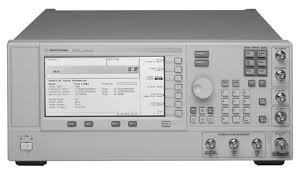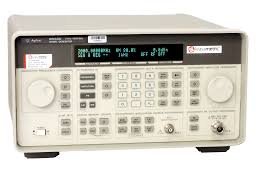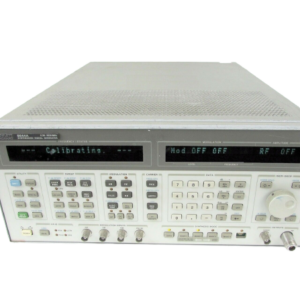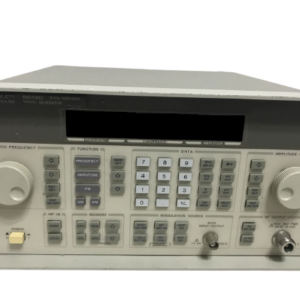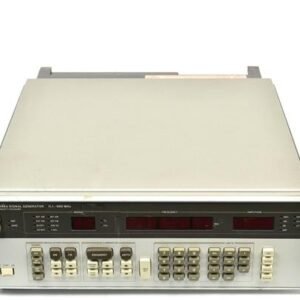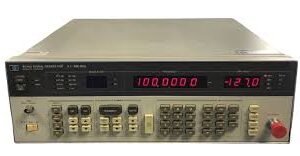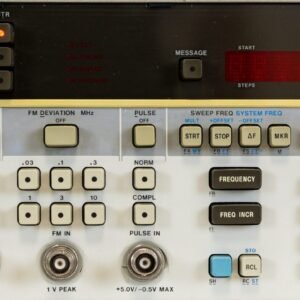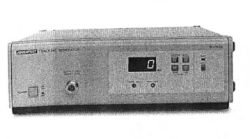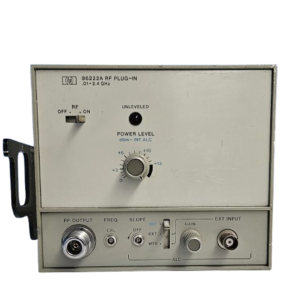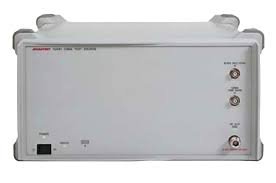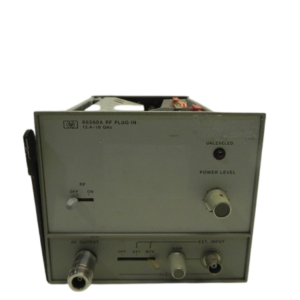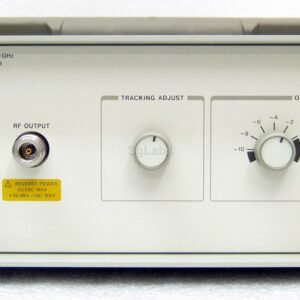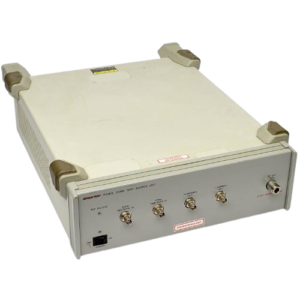
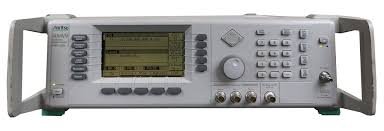

The Anritsu 69337A is a synthesized sweep/signal generator delivering precision wideband signal generation across 2–20 GHz. Built for demanding RF applications, it combines ultra-low phase noise, wide dynamic range output control, and flexible sweep modes to support signal simulation, component characterization, and integration into automated test systems. Multiple modulation types, programmable step sweeping, and high-speed frequency switching enable rapid prototyping and manufacturing test workflows.
Technical Specifications
Frequency Range: 2 GHz to 20 GHz
Frequency Resolution: 1 kHz standard; 0.1 Hz with Option 11
SSB Phase Noise: −100 dBc/Hz at 10 kHz offset from 10 GHz
Output Power Range: −125 dBm to +17 dBm
Sweep Modes:
• Analog, step, and manual sweep
• Sweep width: 1 kHz to full frequency range (0.1 Hz minimum with Option 11)
• Step sweep: 1 to 10,000 steps; dwell 1 ms to 99 seconds
• Frequency switching: Typically <15 ms + 1 ms/GHz step size, or <40 ms (whichever is less)
• Alternate sweep between two independent ranges
• Sweep time: 30 ms to 99 seconds
• Sweep accuracy: ±30 MHz or ±2 MHz width (whichever is less) at ≤50 MHz/ms sweep speed
Modulation: Internal AM, FM, phase modulation, and pulse modulation. User-downloadable complex modulation. Seven internal modulating waveforms including Gaussian noise and arbitrary user-defined waveforms.
Frequency Stability: Phase-locked to internal or external 10 MHz time base; accuracy dependent on selected time base.
– Key Features
• Single coaxial RF output
• Internal/external 10 MHz time base input/output for synchronization
• Low spurious signal levels
• SCPI command programming support
• Software driver compatibility for standard programming environments
– Typical Applications
• Signal simulation and RF component testing
• Local oscillator replacement
• Swept measurements and network analysis
• Automated test equipment (ATE) integration
• Manufacturing and RF development environments
– Compatibility & Integration
The 69337A supports SCPI commands and integrates into existing test frameworks via software drivers, enabling straightforward incorporation into test automation suites and development workflows.