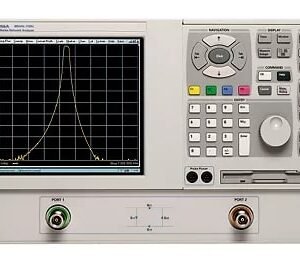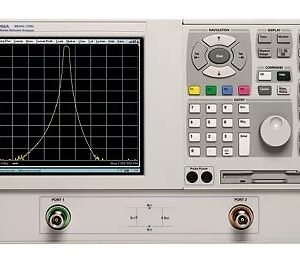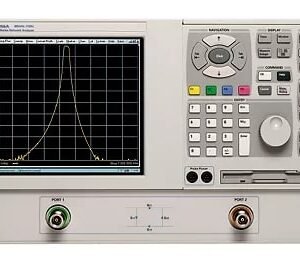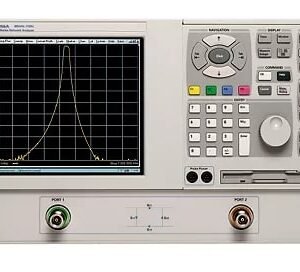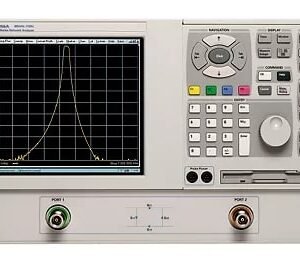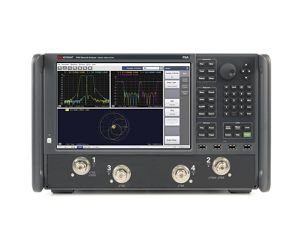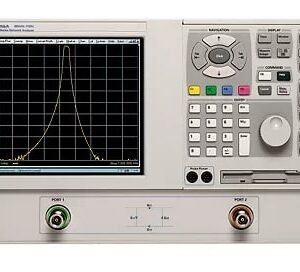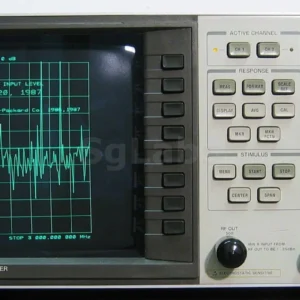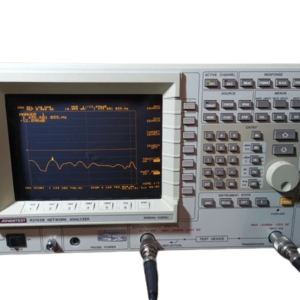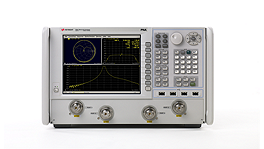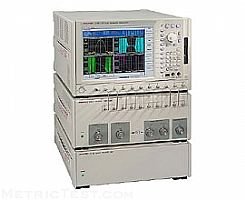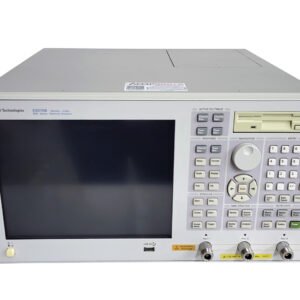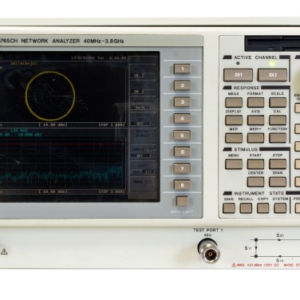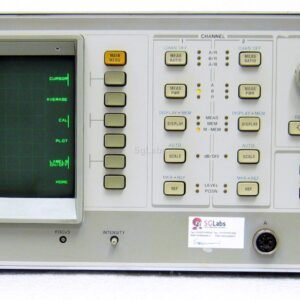
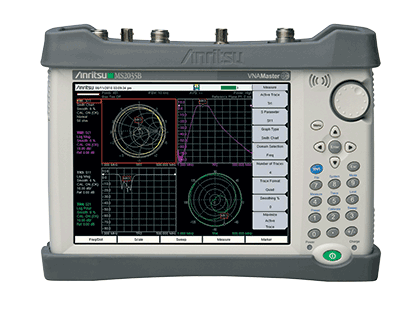

The Anritsu MS2035B is a dual-function Vector Network Analyzer and Spectrum Analyzer delivering integrated RF characterization across 500 kHz to 6 GHz (VNA) and 9 kHz to 6 GHz (SA). This 2-port instrument combines S-parameter measurement, return loss, insertion loss, VSWR, and impedance analysis with broadband spectrum monitoring, making it suitable for base station commissioning, component validation, and field troubleshooting.
## Technical Specifications
**Vector Network Analysis**
• Frequency range: 500 kHz to 6 GHz
• 2-port S-parameter measurement (S11, S21, S12, S22)
• Magnitude accuracy: ±0.1 dB; Phase accuracy: ±1°
• Dynamic range: up to 120 dB
• Measurement parameters: Return Loss, Insertion Loss, VSWR, Impedance, Phase, Group Delay
• Trace types: Log Magnitude, Linear Magnitude, Smith Chart, Real, Imaginary, Group Delay, VSWR, Return Loss, Impedance
• Calibration: SOLT, Response, Isolation, Electrical Delay, Single-Port
• Data points: up to 201 (selectable)
• Sweep modes: Frequency, Power
**Spectrum Analysis**
• Frequency range: 9 kHz to 6 GHz
• Resolution bandwidth: 1 Hz to 5 MHz (1-3-10 sequence)
• Video bandwidth: 1 Hz to 5 MHz (1-3-10 sequence)
• Span: 0 Hz (zero span) to 6 GHz
• Amplitude range: −145 dBm to +30 dBm
• DANL: −145 dBm/Hz (typical, pre-amplifier ON)
• Amplitude accuracy: ±0.5 dB post-calibration
• Phase noise: <−100 dBc/Hz at 100 kHz offset (1 GHz carrier)
• Third-Order Intercept: +15 dBm
• Detector types: Peak, Sample, Average (RMS), Negative Peak
• Trace types: Normal, Average (RMS), Max Hold, Min Hold
## Key Features
• Portable form factor for field deployment
• 2-port VNA with Smith Chart visualization
• Extended low-frequency operation from 9 kHz spectrum monitoring
• Dual-mode measurement in single instrument
## Typical Applications
• Base station installation and commissioning
• RF component characterization
• Impedance and reflection coefficient analysis
• Spectrum occupancy monitoring