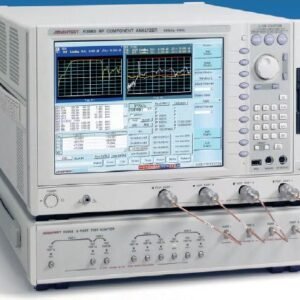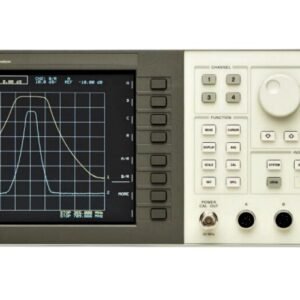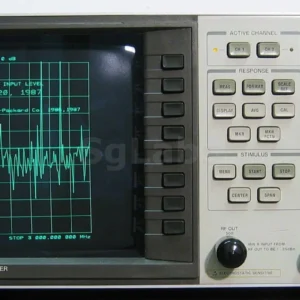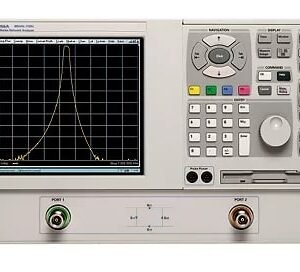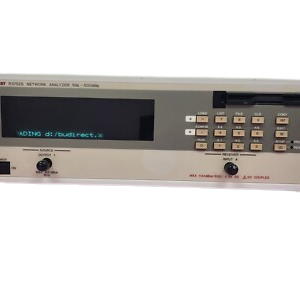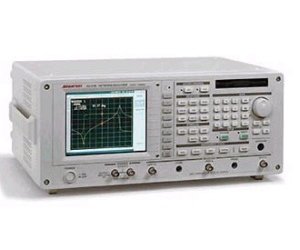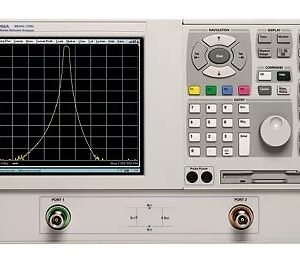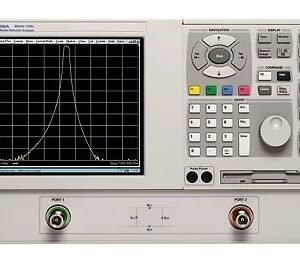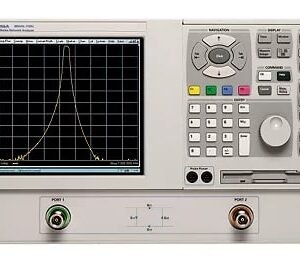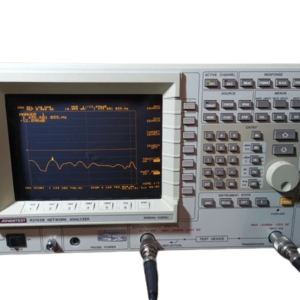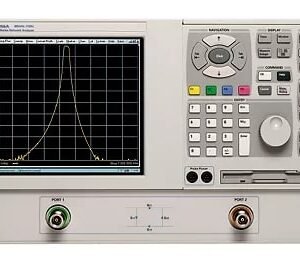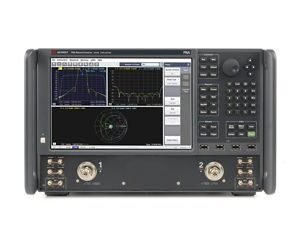
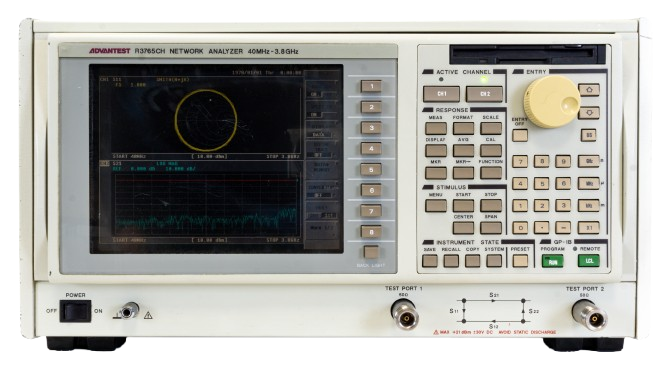

The Advantest R3765BH is a network analyzer engineered for precision impedance matching and high-frequency reflection measurements across 40 MHz to 8.0 GHz. A built-in SWR bridge enables efficient characterization of RF and microwave components, while simultaneous 8-trace capability on a full-color TFT display accelerates design validation and production testing. The instrument measures amplitude, phase, group delay, and impedance with 100 dB dynamic range and 0.5 dB output accuracy. Sweep speeds reach 0.15 ms/point with normalized calibration or 0.25 ms/point under 2-port full calibration, supporting rapid data acquisition in laboratory and manufacturing environments.
Technical Specifications
• Frequency Range: 40 MHz to 8.0 GHz
• Dynamic Range: 100 dB
• Output Accuracy: 0.5 dB
• Sweep Speed: 0.15 ms/point (normalized calibration) or 0.25 ms/point (2-port full calibration)
• Measurement Parameters: Amplitude, phase, group delay, and impedance
• Display: Full-color TFT screen
• Channels: 4 channels supporting 8 simultaneous traces
• Test Set Configuration: Transmission/Reflection
• Power Consumption: 250 VA or less
• Dimensions: 424 mm (W) × 220 mm (H) × 400 mm (D)
• Weight: 18.5 kg or less
• Operating Temperature: +5 to +40°C
• Operating Humidity: 80% or less (non-condensing)
– Key Features
• Built-in SWR bridge for reflection measurements
• 2-port full calibration support
• BASIC controller function integrated as standard
• Programmable limit lines for pass/fail testing
• Electronic output attenuator (optional)
• Software fixture function for impedance normalization other than 50 Ω (optional)
• Multi-port device measurement capability with optional 3-port or 4-port test sets
– Typical Applications
• RF and microwave component characterization
• Impedance matching and filter design
• Transmission line analysis
• Wireless communication device validation
• Production test and quality assurance
– Compatibility & Integration
GPIB, parallel, serial, printer, and keyboard ports enable automated measurement control and external system integration. External reference frequency input and probe power output support specialized measurement configurations.