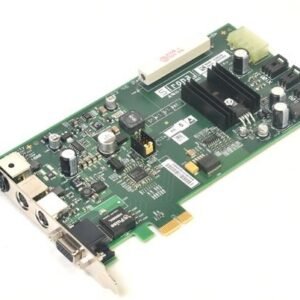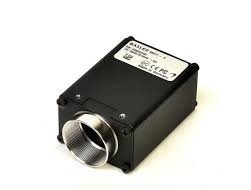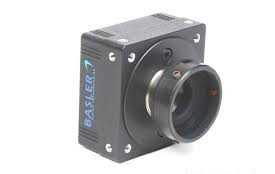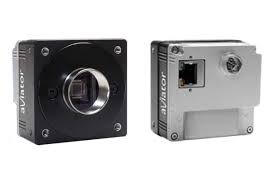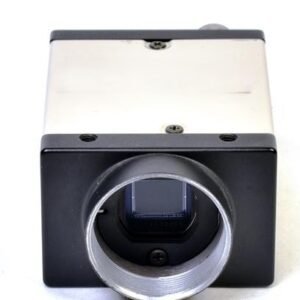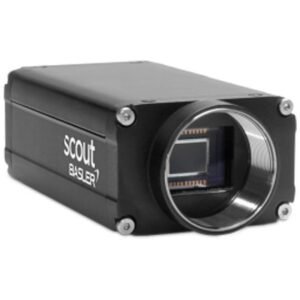
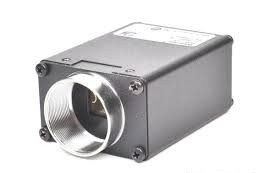

The Basler A622f-UNI is a monochrome CMOS global shutter area scan camera built for industrial and scientific imaging in space-constrained environments. It delivers 100 fps at VGA resolution (656 x 491 pixels) and 25 fps at native 1.3-megapixel resolution (1280 x 1024 pixels). IEEE 1394a FireWire connectivity eliminates the need for external frame grabbers, providing direct plug-and-play integration with 400 Mbit/s data transfer. The compact 29 × 44 mm housing accepts standard C-mount lenses and features 4 opto-isolated input and 4 output ports via RJ-45 connectivity. Electronic exposure control and versatile triggering—including external synchronization, free-run, and patented Trigger Ready modes—optimize capture timing and prevent frame loss.
## Technical Specifications
**Sensor**
• CMOS global shutter, progressive scan
• 1280 × 1024 pixels (1.3 MP)
• 6.70 µm × 6.70 µm pixel pitch
• 11 mm diagonal (2/3″ type)
• Monochrome only
**Performance**
• 100 fps @ VGA (656 × 491)
• 25 fps @ full resolution (1280 × 1024)
• Electronic exposure time control
**Interfaces & Connectivity**
• IEEE 1394a FireWire: 400 Mbit/s
• Power and control via IEEE 1394 socket
• 4 opto-isolated inputs, 5 VDC nominal, 10 mA nominal
• 4 opto-isolated outputs, 2–48 VDC max forward voltage, 100 mA max collector current
• RJ-45 connector for I/O access
• C-mount lens compatibility
## Key Features
• Patented Trigger Ready feature prevents image loss during high-speed acquisition
• Global shutter enables synchronous pixel exposure across the entire sensor
• Compact footprint simplifies integration into OEM systems
• Opto-isolated I/O provides noise immunity in electrically harsh environments
• Single-supply operation via FireWire eliminates external power requirements
## Typical Applications
• Machine vision and quality inspection
• Scientific research imaging
• High-speed motion capture
• Real-time industrial process monitoring
## Compatibility & Integration
The A622f-UNI operates in commercial environments with adequate airflow to maintain housing temperature below 50°C. It meets FCC Part 15 Class A (USA) and Canadian Class A radio noise emission limits. Not suitable for life support applications where malfunction could cause injury.