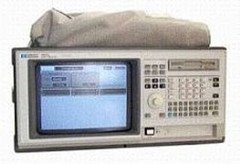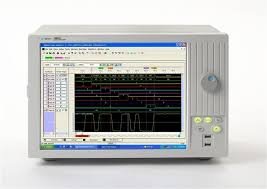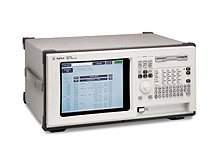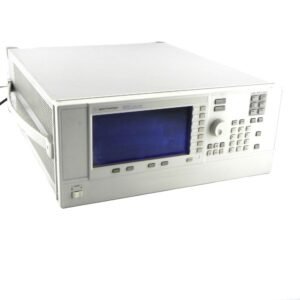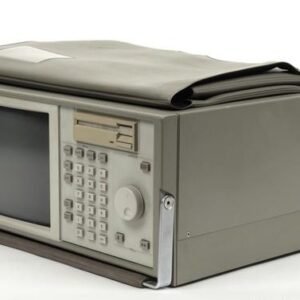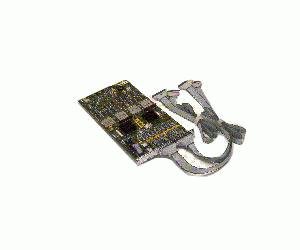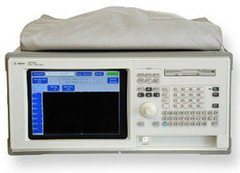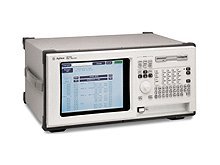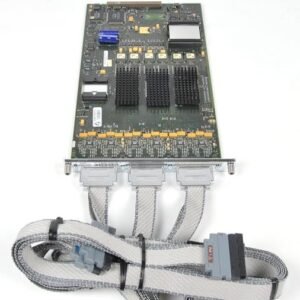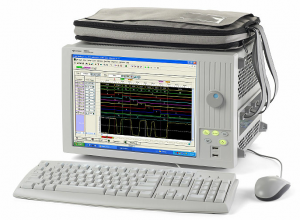
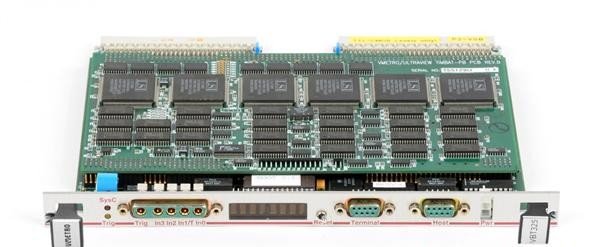

The Curtiss-Wright/VMETRO VBT-325C is a dual-analyzer VMEbus instrument designed for protocol-sensitive capture, monitoring, and analysis of VMEbus systems and configurable P2 bus protocols. It provides simultaneous independent analysis of VMEbus and secondary bus activity—including VSB, SCSI, or user-defined protocols—enabling engineers to diagnose complex multi-bus interactions within a single acquisition window. The instrument captures all VMEbus transactions including arbitration, interrupts, block transfers, and read-modify-write cycles with protocol-aware sampling that derives timing from bus cycles themselves.
## Technical Specifications
**Dual Analyzer Architecture**
• VMEbus analyzer: 101 sampled signals (address, data, control, interrupt, and bus arbitration lines)
• P2 analyzer: 64 configurable signals for VSB, SCSI, or user-defined protocols
• Protocol-sensitive sampling: derives clocks from bus cycles for accurate transaction tracing
**Timing and Analysis Depth**
• State analysis: up to 25 MHz
• Timing analysis: up to 50 MHz (200 MHz optional with TIM200-PB piggyback)
• Trace buffer: 32K samples standard (expandable to 1M samples with XMEM325-PB piggyback)
– VME partition: 32K × 128 bits
– P2 partition: 32K × 64 bits
**Triggering and Sequencing**
• Four full-width word recognizers per bus with address and data range capability
• Trigger sensitivity: 20 ns (5 ns optional)
• 16-level sequencer with conditional logic (If, Else, Elsif, Goto, Count, Delay, Trigger, Store, Sampling mode, Halt)
• Four 20-bit occurrence counters per bus for sequencer control
• Three 20-bit delay counters per bus: 40 ns to 0.33 s range
• Four 20-bit event counters per bus for statistical analysis
• NOT operator on signal groups
**Interface and Control**
• PC-based operation via BusView™ GUI over RS232 connection
• ASCII terminal alternative for remote operation
## Key Features
• Independent, simultaneous analysis of two distinct bus protocols eliminates sequential capture limitations
• Protocol-aware sampling eliminates timing artifacts from external clock derivation
• Flexible triggering with multi-level sequencing enables complex conditional captures
• Expandable memory architecture scales trace depth for long-duration captures
## Typical Applications
• VMEbus system development and validation
• Hardware-software integration debugging
• Multi-bus protocol interaction analysis
• Bus arbitration and interrupt sequence diagnostics
## Compatibility & Integration
Supports standard VMEbus signals and VSB, SCSI, or customer-defined P2 protocols. Optional piggyback modules extend timing analysis and trace memory capacity.