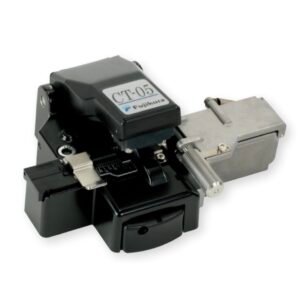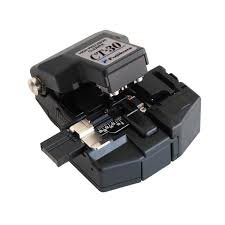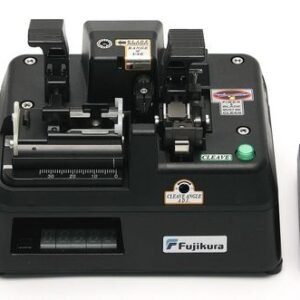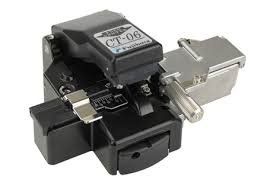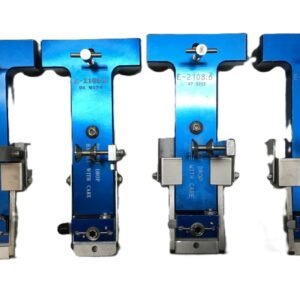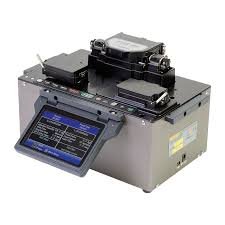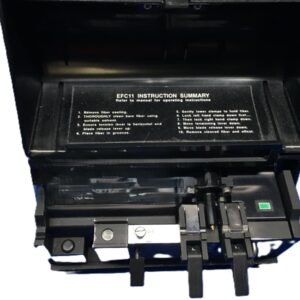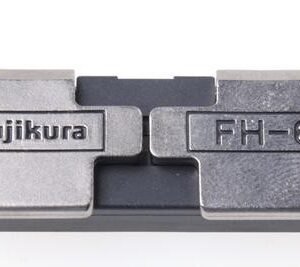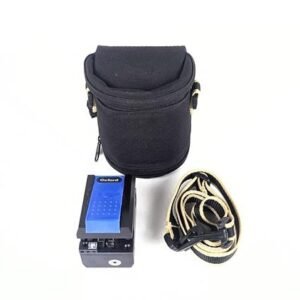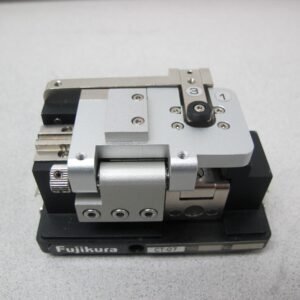
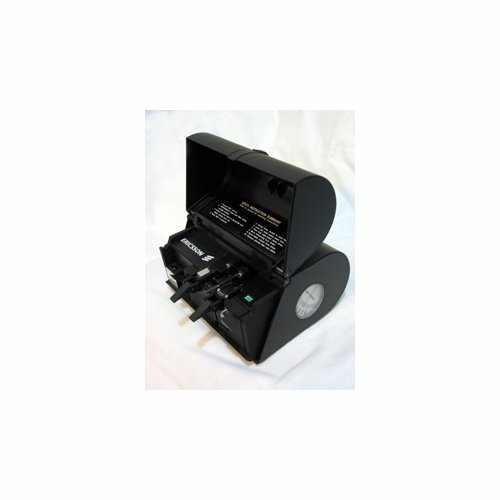

The Ericsson Fiber FSU EFC11 ultrasonic fiber cleaver with double grip produces precision, low-angle cleaves for fusion splicing in optical networks. Unlike conventional cleavers, this tool uses ultrasonic vibration of a precision diamond blade attached to a resonant acoustic horn, eliminating compressive stresses and blade intrusion. The result is superior end-face quality with minimal hackle and misting. The dual-grip mechanism maintains consistent fiber tension throughout the cleaving cycle, ensuring repeatable performance across laboratory and field deployments.
Technical Specifications
Cleaving Mechanism
• Ultrasonic vibration–driven precision diamond blade on resonant acoustic-stepped horn
• Vibrating blade rides on frictionless damped bearings
• Electronic circuit maintains ultrasonic resonance with automatic termination for battery conservation
Fiber Compatibility
• Single-mode and multi-mode optical fibers
• Fiber diameter: 80–200 µm
• Maximum fiber buffer diameter: 250 µm (EFC11 model)
Cleave Quality & Performance
• Mirror-quality planar fiber ends with no hackle
• End angle consistency: < 1°
• Cleave angle repeatability: 20,000 cleaves
Operation & Power
• Power source: 9 V alkaline battery (MN 1604)
• Battery life: Approximately 10,000 cleaves
• Operation: Stripped fiber placed in low-torsion V-groove clamps; axial tension applied via lever; cleaving initiated by releasing secondary lever
Physical Dimensions
• Size: 150 × 150 × 68 mm
• Weight: 1.2 kg (2.6 lb)
– Key Features
• Ultrasonic vibration eliminates compressive stress during cleaving
• Double-grip mechanism ensures consistent fiber tension and repeatability
• Adjustable diamond blade extends tool life and reduces consumable costs
• Compact form factor suitable for bench and field operations
– Typical Applications
Fusion splicing preparation in optical network installation, maintenance, and laboratory environments requiring high-quality end-face geometry and minimal splice loss.