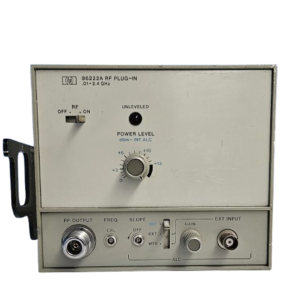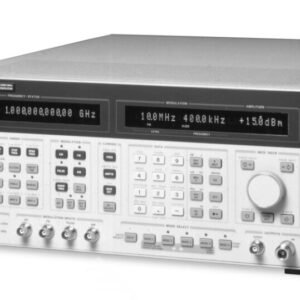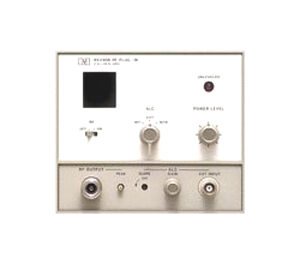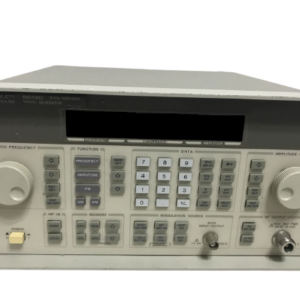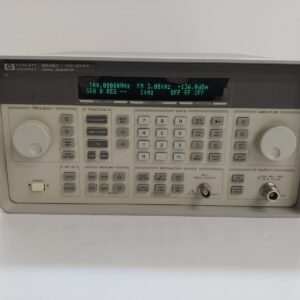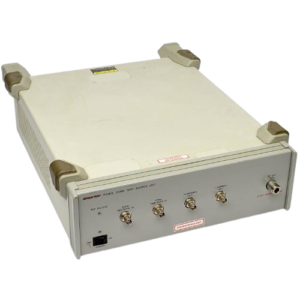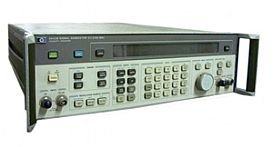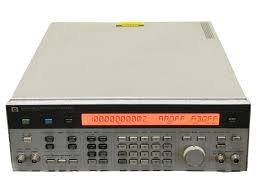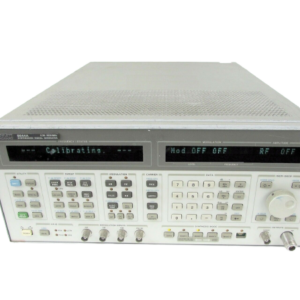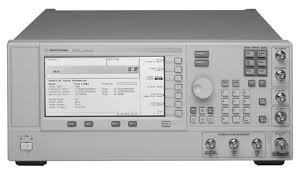
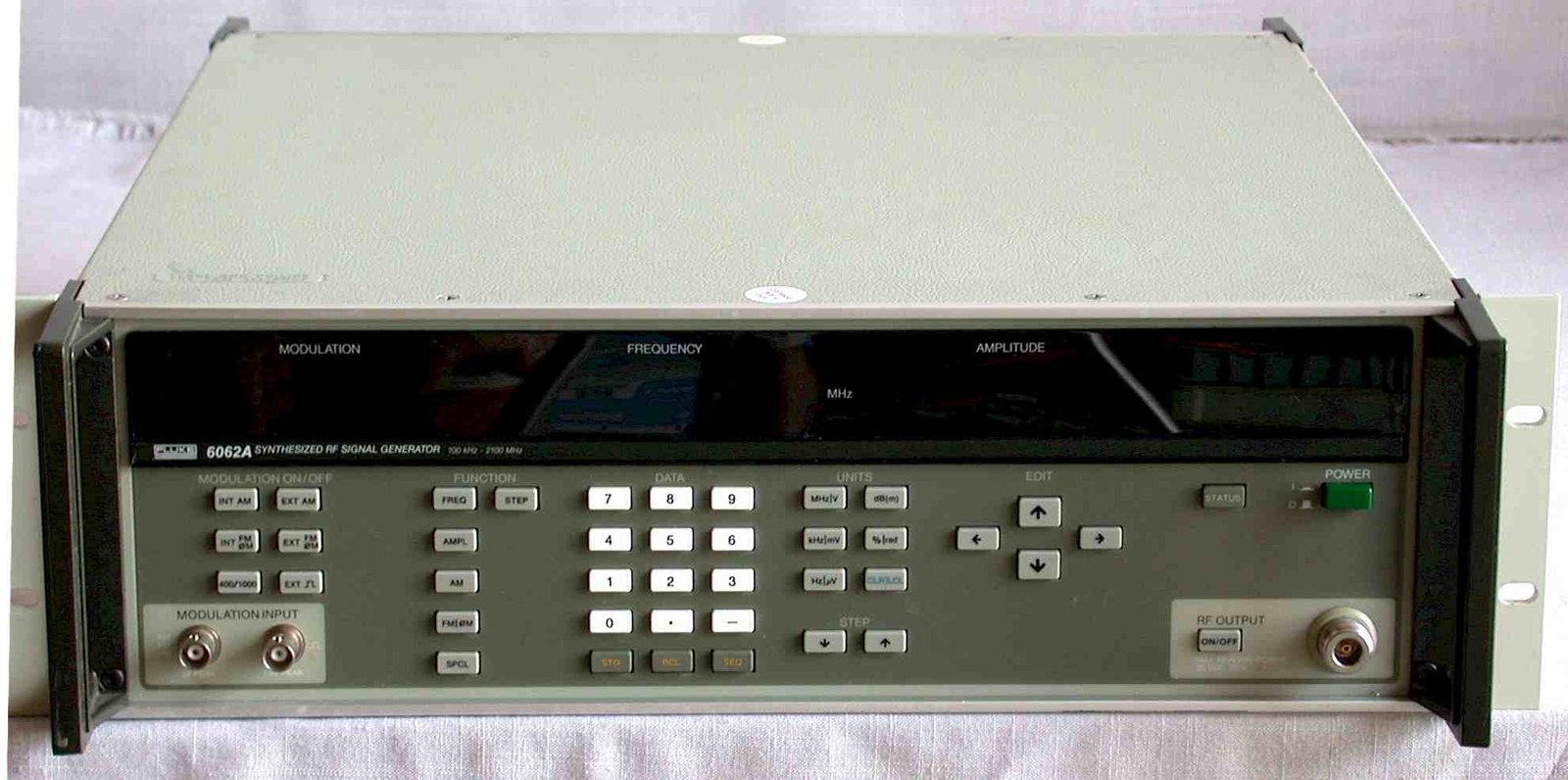

The Fluke 6062A/AG is a synthesized signal generator engineered for RF testing, communications systems evaluation, and component characterization. It delivers precise frequency synthesis across 100 kHz to 2.1 GHz with output levels spanning +16 dBm to −137 dBm, supported by multiple modulation modes and exceptional spectral purity. The instrument integrates GPIB/IEEE-488 control, making it suitable for both benchtop measurement and automated test environments.
## Technical Specifications
**Frequency & Resolution**
• 100 kHz to 2.1 GHz operating range
• 10 Hz frequency steps and resolution from 0.1 to 1050 MHz
• 20 Hz frequency steps and resolution from 1050 to 2100 MHz
**Output Power**
• +16 dBm to −137 dBm (0.1 to 1050 MHz)
• +13 dBm to −137 dBm (1050 to 2100 MHz)
• 0.1 dB programmable steps with autoranging 6 dB step attenuator
**Amplitude Accuracy**
• ±1.5 dB across specified operating ranges
• ±2.0 dB from +16 to −127 dBm (0.1 to 999.99999 MHz)
**Modulation**
• AM, FM, phase, and pulse modulation modes
• AM depth: 0 to 99% in 1% increments
• FM deviation: 1, 10, 100, and 400 kHz selectable
• Phase deviation: 0.10, 1.0, 10.0, and 40.0 radians
• Internal modulation oscillator: 400 to 1000 Hz selectable
• Pulse modulation: 15 nanosecond rise and fall time (GaAs), ~50% internal duty cycle
• External pulse: DC to 16 MHz rates, 0 to 100% duty cycle adjustable
**Spectral Purity**
• Non-harmonic spurious: <−60 dBc (0.1 to 1049.99999 MHz)
• Non-harmonic spurious: 10 kHz offset)
• Harmonics: <−30 dBc
• Fixed frequency spurs: <−60 dBc or <−140 dBm (whichever larger)
**Time Base**
• Crystal time base with ±0.5 ppm/month ageing rate and ±5 ppm at 25°C
• Optional medium-stability or ovenized high-stability time bases
• External reference: 1, 2, 2.5, 5, or 10 MHz input (0.3 to 4.0 Vpp into 50 Ω termination)
**Physical & Integration**
• Weight: 15 lbs; Dimensions: 20 × 18 × 12 inches
• Rack-mountable (5.25 inches high)
• VFD display
• GPIB/IEEE-488 interface (standard)
## Key Features
• Dual time base options for varying stability requirements
• Programmable output in 0.1 dB steps across full dynamic range
• External reference frequency input for synchronization
• Pulse modulator with nanosecond-class switching speed
• Low spurious profile suitable for sensitive receiver testing
## Typical Applications
• Communication system transmitter/receiver verification
• RF filter and amplifier characterization
• Phase-locked loop and frequency synthesizer evaluation
• Modulation quality assessment across AM, FM, and phase modes
• Pulse-based system component testing
## Compatibility & Integration
Standard GPIB/IEEE-488 connectivity enables remote control and integration into automated test systems, simplifying multi-instrument coordination for production and development environments.