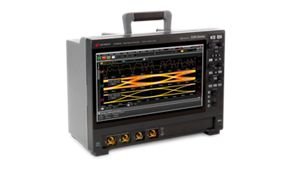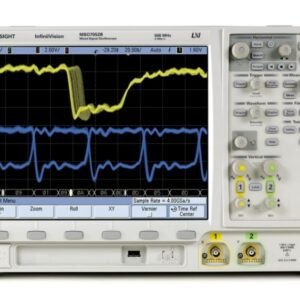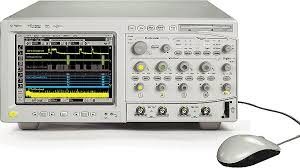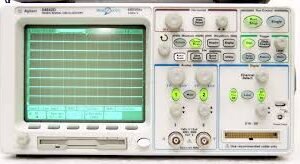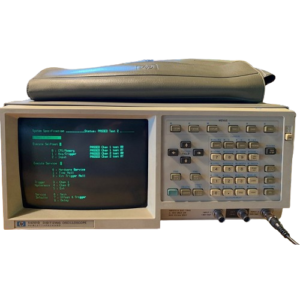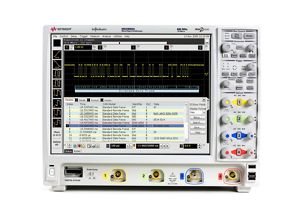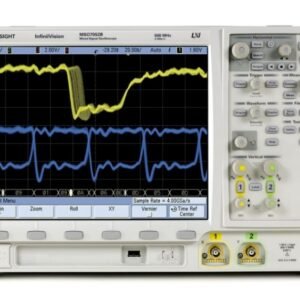
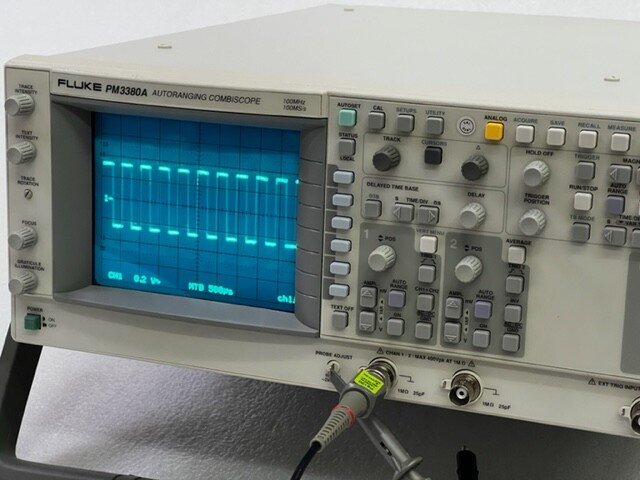

The Fluke PM 3384A Autoranging CombiScope is a 100 MHz, 4-channel instrument that transitions between analog and digital storage oscilloscope modes for comprehensive signal analysis. Built on hybrid architecture, it delivers real-time sampling at 200 MS/s with equivalent sampling up to 10 GS/s on repetitive signals, making it suitable for electronics troubleshooting, component characterization, and transient capture across industrial and laboratory environments.
Technical Specifications
Oscilloscope Core
• Bandwidth: 100 MHz
• Channels: 4 analog input channels
• Display: 7-inch color CRT
• Peak detection: Captures glitches as narrow as 5 ns
Digital Storage Mode
• Real-time sample rate: 200 MS/s maximum
• Equivalent sample rate (repetitive): Up to 10 GS/s (sine interpolation)
• Single-shot mode frequency limits (5 samples/period, sine interpolation):
– 1 channel: 40 MHz
– 2 channels: 20 MHz
– 4 channels: 1 MHz
• Acquisition memory: 8K standard; optionally expandable to 32K samples
• ADC resolution: 8-bit; memory resolution: 16-bit
• Waveform storage: 10 waveform memories; optional storage for 200+ traces
• Math functions: Add, Subtract, Multiply, Divide; optional Math+ module adds integration, differentiation, histogramming, and FFT
• Trigger modes: Pattern, state, and glitch triggering (2 ns); TV triggering including HDTV and TV line selection
• Acquisition: Pre-trigger/post-trigger support; single-shot four-channel capture with timebase to 625 ns/div using sine interpolation
Analog Oscilloscope Mode
• Full attenuator control on all four input channels
User Interface
• Autoset function: Instant optimized signal display for all channels plus external trigger input
• Autocal: Automatic fine adjustment for environmental variation compensation
• Trigger View: External trigger input displayable as third input channel
– Key Features
• Dual-mode operation (analog/digital) in single instrument
• Signal averaging reduces noise and increases vertical resolution
• Pre-trigger and post-trigger acquisition for complete event capture
• Narrow glitch capture at 5 ns minimum pulse width
– Typical Applications
Digital circuit verification, transient analysis, embedded system debugging, switching power supply characterization, and real-time signal troubleshooting in manufacturing and service environments.
– Compatibility & Integration
Originally developed by Philips, now Fluke. Operates in both analog and digital storage modes within a single platform.