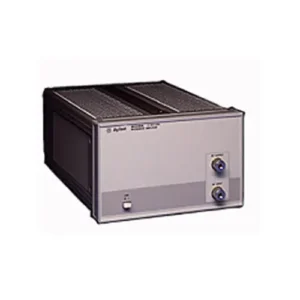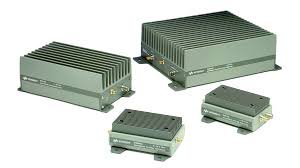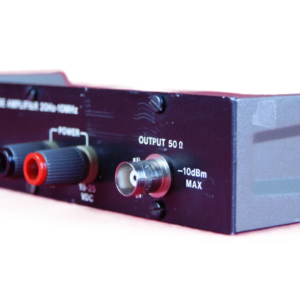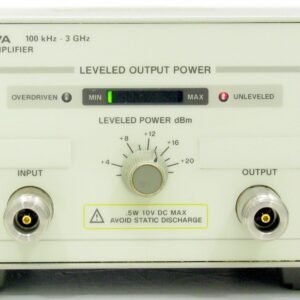
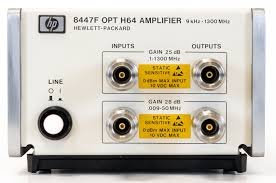

The Hewlett Packard 8447F OPT H64 is a dual-channel wideband preamplifier designed for RF and microwave signal conditioning across extended frequency ranges. Built on thin-film hybrid integrated circuits with solid-state power supply architecture, this instrument delivers low-noise amplification with flat frequency response suitable for laboratory, test, and communication system integration. The OPT H64 configuration provides two independent preamplifiers with distinct frequency coverage and gain characteristics, enabling flexible signal processing from 9 kHz to 1300 MHz.
Technical Specifications
Preamplifier 1 (Low Frequency)
• Frequency Range: 9 kHz to 50 MHz
• Minimum Gain: 26 dB
• Gain Flatness: ±2 dB
Preamplifier 2 (High Frequency)
• Frequency Range: 100 kHz to 1300 MHz
• Minimum Gain: 25 dB
• Gain Flatness: ±1.5 dB
General Specifications
• Impedance: 50 Ω
• Input VSWR (1 to 1300 MHz): <2.0:1
• Output VSWR (1 to 1300 MHz): <2.2:1
• Maximum DC Input Voltage: ±10 V
• Group Delay Variation: Typically <0.15 ns over any 50 MHz band (0.1–1300 MHz)
• Power Requirements: 115 or 230 Vac ±10%, 48 to 440 Hz, 15 W, 27 VA max
• Operating Temperature: 0°C to +55°C
• Storage Temperature: -40°C to +75°C
• Connector: Type-N Female
• Weight: 3 lbs. 14 oz. (1.75 kg)
• Dimensions: 8.5 × 5.125 × 3.375 inches (216 × 130 × 85.8 mm)
– Key Features
• Dual-preamplifier configuration for simultaneous low and high frequency operation
• Thin-film hybrid construction ensures reliability and performance stability
• Solid-state power supply eliminates transformer requirements
• Type-N connectors provide standard RF integration
• Benchtop instrument with optional rack-mount capability via adapter frame
– Typical Applications
• RF/microwave signal measurement and detection
• Sensitivity enhancement for spectrum analysis
• Low-frequency and wideband signal conditioning
• Test and measurement system front-end amplification
– Compatibility & Integration
The two internal preamplifiers operate independently or in cascade configuration, allowing flexible implementation across diverse measurement architectures.