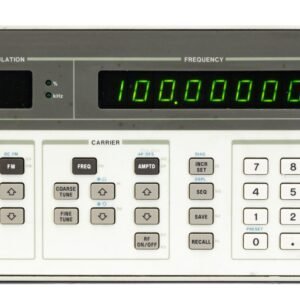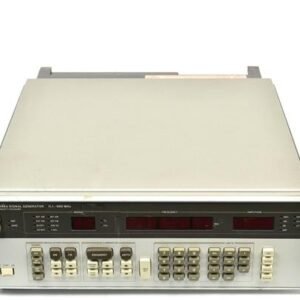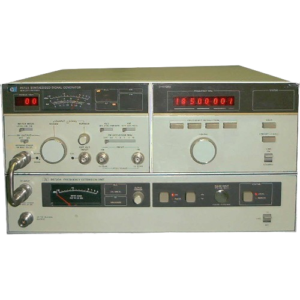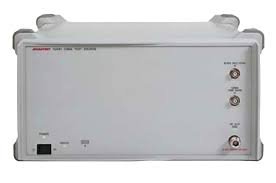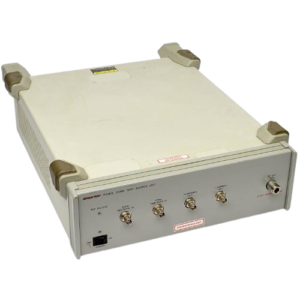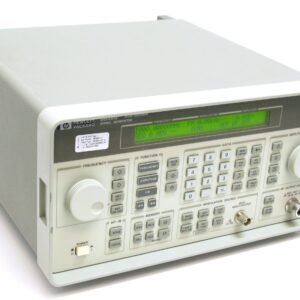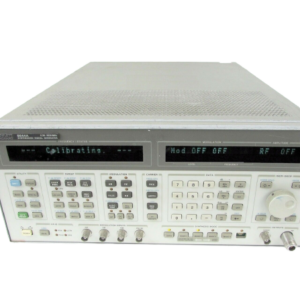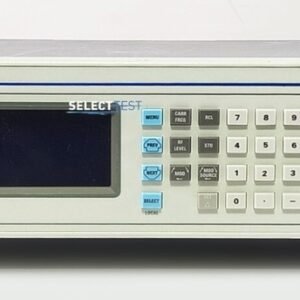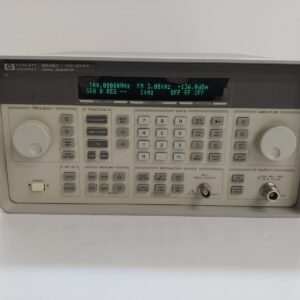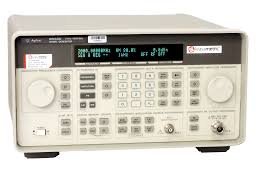
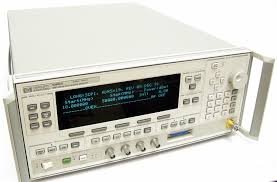

The HP/Agilent 83650L is a synthesized swept-CW generator delivering precise RF and microwave signal generation from 10 MHz to 50 GHz. It combines the accuracy of a synthesized source with sweep flexibility, enabling complex stimulus/response testing across aerospace, defense, and communications applications.
## Technical Specifications
**Frequency Performance**
• Operating range: 10 MHz to 50 GHz
• Resolution: 1 kHz standard (1 Hz with Option 008)
• Switching time: 10 ms typical without attenuator change; 15 ms + (step size/1 GHz) × 5 ms for frequency band steps; 5 ms with narrow steps
• SSB phase noise: < −80 dBc/Hz at 10 GHz, 10 kHz offset
• Harmonics: −50 dBc typical below 26.5 GHz
• Aging rate: 5 × 10⁻¹⁰/day
**Output Power**
• Calibrated output: +2.5 dBm
• Maximum: 10 dBm below 26 GHz; 2.5 dBm above 40 GHz
• Leveled output reduction: 1.5 dB to 20 GHz; 2 dB above 20 GHz; 2.5 dB above 40 GHz
• Standard minimum: −20 dBm
• With Option 001 attenuator: −110 dBm minimum
• Level resolution: 0.02 dB
**Sweep Capabilities**
• Modes: CW, step, list, manual, ramp, and analog power sweep
• Step/list points: 2 to 801 per table
• Dwell time: 100 µs to 3.2 s
• Triggers: Auto, external, single, or GPIB
## Key Features
• 1 kHz frequency resolution enables fine-grain tuning for precision characterization
• User flatness correction accommodates operational modes (CW, step, list, manual, and ramp sweep)
• Multiple sweep modes support diverse test scenarios from transient response to frequency-dependent behavior
• Output level specifications maintain accuracy across 15 °C to 35 °C operating window
• Modulation options compatible with Agilent 8360B series; pulse modulation available above 400 MHz
## Typical Applications
• Component and subsystem characterization in RF/microwave design
• Frequency response and gain flatness measurement
• Stimulus/response testing for amplifiers and filters
• Aerospace and defense signal simulation
• Communications system validation
## Compatibility & Integration
GPIB trigger support enables automated test sequencing. AC power supply requires proper line voltage selector and grounding via three-prong cord. Cabinet installation demands unrestricted convection; ambient temperature must remain 4 °C below instrument maximum for every 100 watts cabinet dissipation.