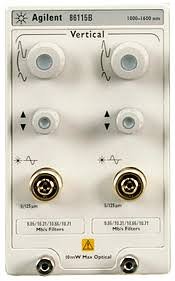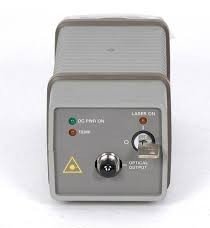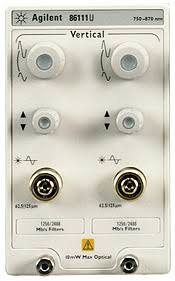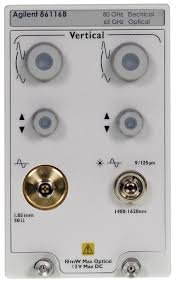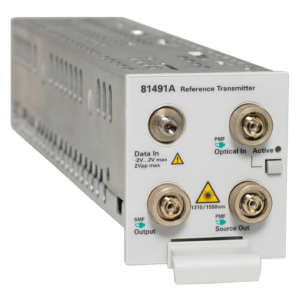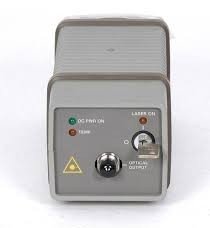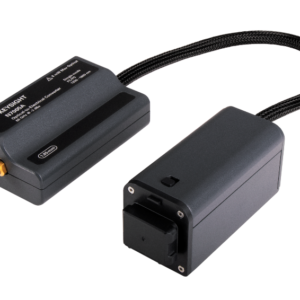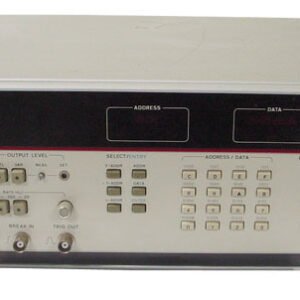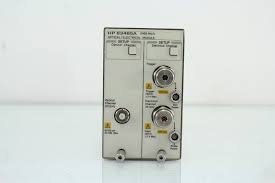
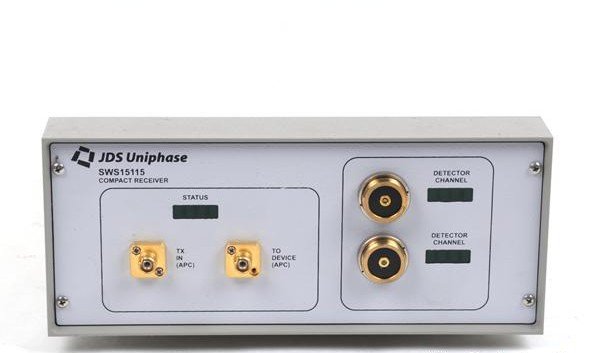

The JDSU SWS15115 is a dual-channel compact receiver designed as a core component of the JDSU SWS15100/SWS16100 Swept Wavelength System for characterizing wavelength dependence of passive optical components. The receiver integrates dual optical detectors—one reference and one for device-under-test (DUT)—enabling precise ratio measurements across the optical spectrum. Operating as a distributed-architecture station, the SWS15115 connects to a tunable laser source transmitter via a single optical fiber, eliminating the need for multiple connections and enabling simultaneous multi-channel testing. This modular design scales to 128 simultaneous channels with additional chassis and detector modules, while a single transmitter supports nominally four independent receiver stations.
Technical Specifications
• Detector Configuration: Dual-channel detector module with integrated optical detectors
• Optical Interface: FC/APC connector (optical interface sold separately)
• Wavelength Coverage: C-band (1520–1570 nm) and L-band (1541–1630 nm) via compatible transmitters; optional dual-band selector switch enables full C and L-band coverage in single trace
• Wavelength Accuracy: ±3 pm (±0.003 nm) for SWS15100/SWS16100 systems
• Sweep Speed: 20 nm/s system speed; characterizes 40-channel DWDM in less than 90 seconds
• Status Indicator: Equipped with status monitoring
– Key Features
• Modular, distributed architecture requiring only single optical fiber per receiver station
• Dual-detector configuration for reference and DUT measurements
• Scalable to 128 channels with additional modules
• High wavelength accuracy and speed for efficient component characterization
• Optional C+L band switching for broadband testing
– Connectivity & Integration
• Interfaces with JDSU SWS15100/SWS16100 tunable laser source transmitters
• Data transfer via parallel port connector or optional data acquisition board
• Single optical fiber link per station reduces physical interconnect complexity
– Typical Applications
Wavelength-dependent characterization of optical filters, multiplexers, dispersion compensators, and other passive components across C-band and L-band telecommunications wavelengths.