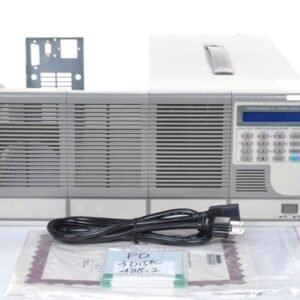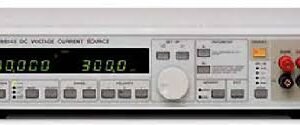
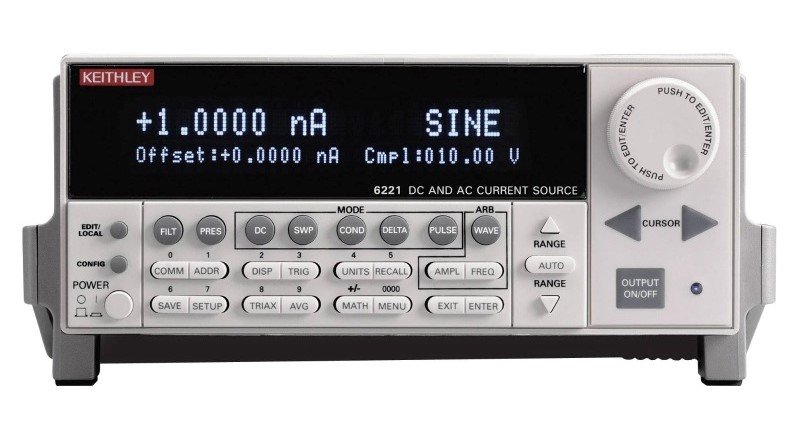

The Keithley 6221 is a precision AC and DC current source engineered for applications requiring stable, accurate current output across picoampere to milliampere levels. It delivers both AC and DC sourcing with four-quadrant capability, supporting source and sink operation up to 100 mA. The instrument combines low noise performance with high output impedance (>10¹⁴ Ω on sensitive ranges) and exceptional current regulation (10¹⁴ Ω (2 nA and 20 nA ranges)
• Output Capacitance: <10 pF (2 nA and 20 nA ranges); <100 pF with filter ON
• Current Regulation (Line/Load): <0.01% of range
• Maximum Output Power: 11 W (four-quadrant operation)
• Output Update Rate: 10 MHz
Waveform Generation
• Types: Sine, Square, Ramp, plus 4 user-defined arbitrary waveforms
• Frequency Range: 1 mHz to 100 kHz
• Arbitrary Waveforms: 2 to 64K points, 16-bit amplitude resolution, 10 MSPS sample rate, 100 ns + 0.1% of period jitter (RMS)
Pulsed Measurements
• Programmable pulse widths as short as 5 µs
• Minimum pulse width for I-V (with 2182A): 50 µs
• Pulse interval: 83.3 ms to 5 s
• Measurement start: 16 µs after pulse application (with 6221/2182A)
Source Memory & Noise
• Memory capacity: 65,000 points (64K) for test sweeps
• RMS Noise (10 Hz–20 MHz, 2 nA–20 mA range): <1 mVrms, 5 mV peak-to-peak (into 50Ω)
– Key Features
• Four-quadrant sourcing with stable load impedance into 10 µH (typical)
• High-resolution arbitrary waveform generation with 16-bit amplitude control
• Direct execution of comprehensive test current sweeps from onboard memory
• Microsecond rise times achievable across all current ranges
• Programmable pulse capabilities for transient and pulsed I-V characterization
– Typical Applications
• Device characterization (diodes, transistors, photosensors)
• Low-level resistance and impedance measurement
• Leakage current analysis
• Capacitive device testing
• Pulsed I-V measurements with synchronized detection
– Compatibility & Integration
The 6221 integrates with the Keithley 2182A Nanovoltmeter for synchronized pulsed measurements, enabling measurement start times as short as 16 µs after pulse application.