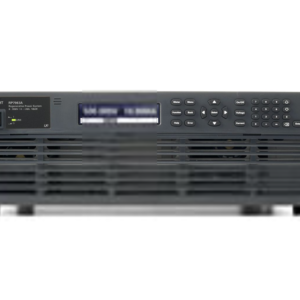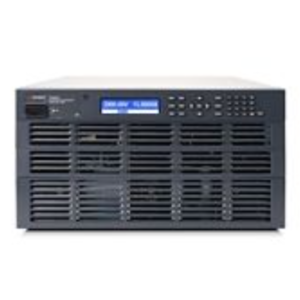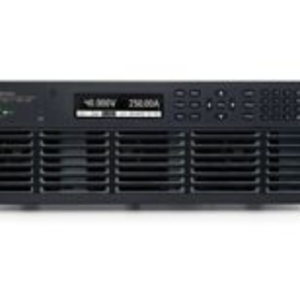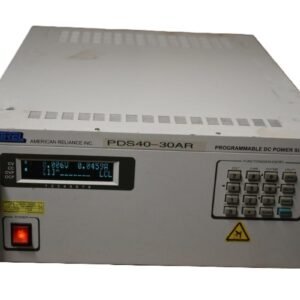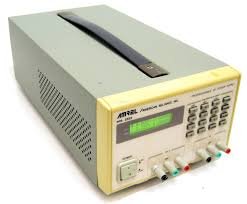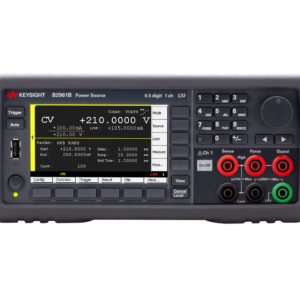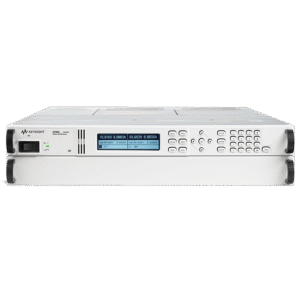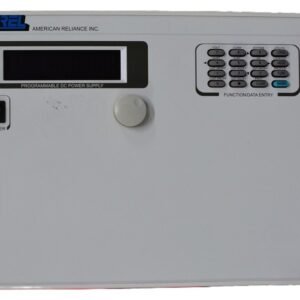
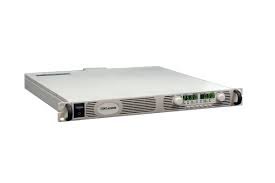

The TDK-Lambda GEN30-50 is a 1500W programmable DC power supply in 1U rack-mount form factor, delivering 0–30V at 0–50A for industrial, laboratory, and OEM applications. It accepts single-phase AC input from 85–265VAC at 47–63Hz and achieves 86% typical efficiency. The unit operates as both constant voltage and constant current source with automatic mode switching, featuring ultra-low ripple noise (0.008Vrms, 0.125Arms across 5Hz–1MHz bandwidth) and excellent regulation: line regulation ≤0.01% + 2mV (CV) or ≤0.01% + 2mA (CC), load regulation ≤0.05% + 2mV (CV) or ≤0.1% + 2mA (CC). Remote sensing is supported for precision applications.
## Technical Specifications
**Output Performance:**
• Rated voltage: 30V DC
• Rated current: 50A
• Rated power: 1500W
• Voltage ripple/noise: 0.008Vrms (5Hz–1MHz)
• Current ripple/noise: 0.125Arms (5Hz–1MHz)
• Programming resolution: 0.012% of rated voltage or current
• OVP/UVL programming: 0.1% of rated voltage
**Input Specifications:**
• AC input: 85–265VAC single-phase
• Frequency: 47–63Hz
• Efficiency: 86% typical
**Control & Interfaces:**
• Standard: RS-232, RS-485
• Optional: LAN (LXI compliant), GPIB (IEEE 488), USB 2.0
• Analog programming: 0–5V, 0–10V, or 4–20mA isolated control
• Front panel: 16-bit A/D and D/A converters with coarse/fine adjustment and dual digital display
• Monitor output: 0–5V or 0–10V analog readback
• LabVIEW drivers available
## Key Features
• Over Voltage Protection (OVP) and Over Current Protection (OCP)
• Safe mode and auto-restart selectable operation
• Series/parallel connection capability for system expansion
• Dimensions: 422.8mm (W) × 43.6mm (H) × 432.8mm (D)
• Weight: 8.5kg
## Typical Applications
Component testing, burn-in operations, system integration, bench laboratory work, and automated test equipment requiring precise voltage/current sourcing with networked or analog control.
## Compatibility & Integration
Multiple units support series and parallel configurations. RS-232/RS-485 standard connectivity enables integration into SCPI-based test systems, while optional LAN and GPIB interfaces support legacy and modern instrumentation standards. Isolated analog control inputs allow integration with PLC and analog control systems.