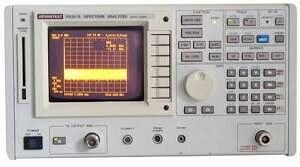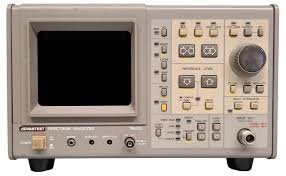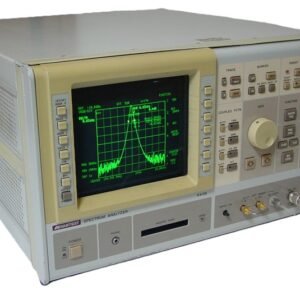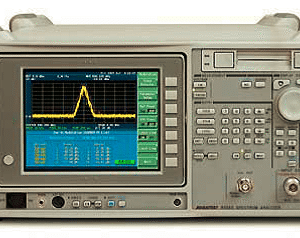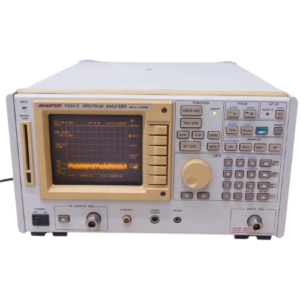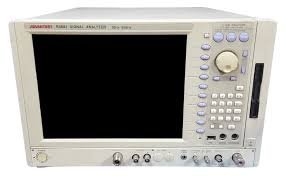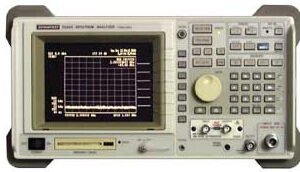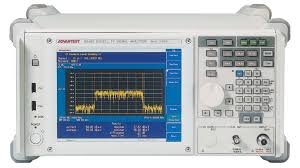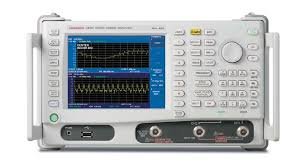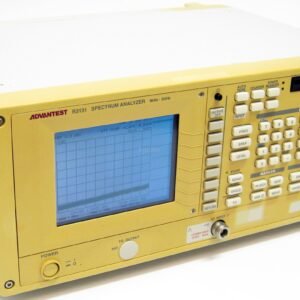

The Marconi IFR Aeroflex 2310 is a signal analyzer engineered for TETRA transmitter characterization across 100 MHz to 2.4 GHz. Built on single-stage down-conversion architecture with low phase noise local oscillator and high-performance digital IF processing, it delivers time-domain signal digitization followed by FFT-based frequency-domain analysis. The instrument directly measures all TETRA base station and terminal power classes without external attenuation, handling up to 50 W with TETRA-like burst profiles.
Technical Specifications
Frequency Coverage
• 100 MHz to 2.4 GHz (general)
• 100 MHz to 1000 MHz (TETRA mode)
Power Handling & Input Ranges
• Continuous power: 40 W
• Burst power (TETRA profile): up to 50 W
• High power input: +3 dBm to +46 dBm
• Lower power input: −10 dBm to +27 dBm
• Maximum sensitivity setting: −20 dBm to +27 dBm
Dynamic Range & Sensitivity
• Spectrum analysis dynamic range: >80 dB (instantaneous for ACP and Power Profile)
• Third-order intermodulation free dynamic range: −90 dBc (two tones at −26 dBm input mixer)
• Maximum sensitivity: −150 dBm in 1 Hz bandwidth
Amplitude Accuracy
• Absolute amplitude: ±0.5 dB (post-self-calibration, 100 MHz to 1 GHz, 25°C ±5°C)
– Key Features
TETRA Transmitter Measurements (ETSI ETS 300 394-1)
• Average transmitter output power
• Power vs. time profiling
• Adjacent Channel Power (ACP) due to modulation, switching, and linearization
• Unwanted power in non-active transmit state
• Modulation and frequency accuracy
• Wideband noise emissions
• Discrete spurious emissions
• Intermodulation attenuation
Signal Analysis Capabilities
• TETRA spectrum display
• Modulation analysis with vector and constellation diagrams
• Single TETRA burst capture with phase and magnitude data for symbol extraction
• Error Vector Magnitude (EVM) measurement
• Phase and amplitude error trending
Wideband Noise Measurement
• Coverage: 100 MHz to 2.4 GHz
• Measured through TETRA filter at offsets >100 kHz from on-channel
• User-configurable frequency offsets: up to 20
Discrete Spurious Emissions
• Frequency range: 100 MHz to 1 GHz
• Up to 20 user-specified measurement frequencies
• Average power measurement across 20 bursts per frequency
– Typical Applications
• TETRA base station and terminal compliance testing
• Direct mode radio characterization
• Modulation quality assessment
• Spurious and harmonic emission detection
• Noise floor and wideband emission profiling
– Compatibility & Integration
The 2310 accepts TETRA signals directly across its operating range without requiring external attenuation networks, simplifying field test and manufacturing bench setups.