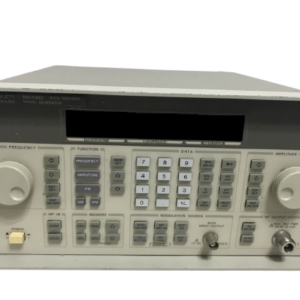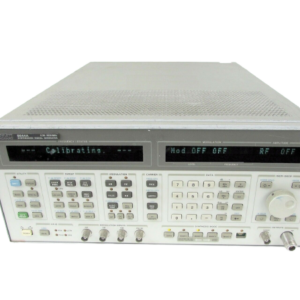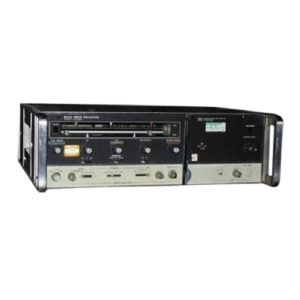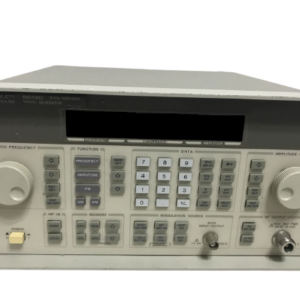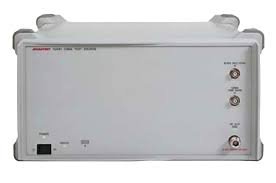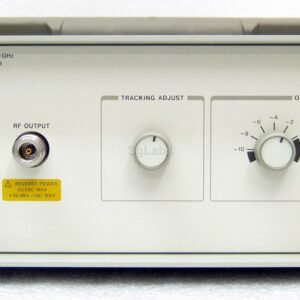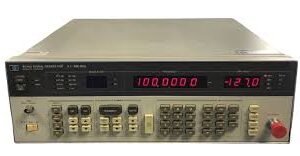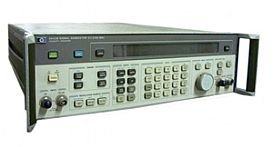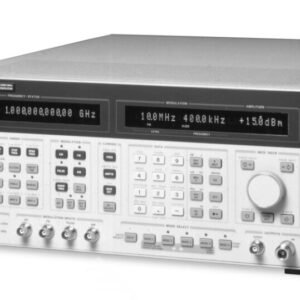

The Marconi IFR Aeroflex 3412 is a digital RF signal generator spanning 250 kHz to 2 GHz, engineered for RF testing, development, and maintenance across wireless communication systems. It delivers +16 dBm peak output with 0.01 dB resolution and includes vector modulation up to 55 MHz bandwidth, analog modulation (AM to 30 MHz, FM to 20 MHz), phase modulation to 10 radians, and optional pulse and FSK capabilities. Spectral purity reaches 1.5 Hz residual FM at 1 GHz with noise floor better than -148 dBc/Hz. The instrument features fast settling times, optional List Mode for frequency hopping (<500 µs), and multiple RF optimization modes. High-stability OCXO frequency standard and reverse power protection are included.
Technical Specifications
• Frequency Range: 250 kHz to 2 GHz
• RF Output Power: Up to +16 dBm peak; 0.01 dB level resolution
• Residual FM: Typically 1.5 Hz at 1 GHz
• Noise Floor: Typically better than -148 dBc/Hz
• Vector Modulation Bandwidth: Up to 55 MHz
• AM Bandwidth: Typically up to 30 MHz
• FM Bandwidth: Typically up to 20 MHz
• Phase Modulation: 0 to 10 radians (0.01 radian resolution)
• Internal Modulation Oscillator: Two tones, 0.1 Hz to 50 kHz (16 MHz with Option 005 ARB)
• List Mode Settling Time: <500 µs (Option 010)
• Waveform Options: Sine, square, triangular, sawtooth
– Key Features
• User-defined RF level limit for component protection
• Single key-press modulation enable/disable
• Combined internal and external modulation sources
• Patented DC FM system minimizing carrier frequency error
• High-stability OCXO frequency standard
• RF optimization modes: Auto, Low Noise, Low ACP, Higher Power
• Fast-responding reverse power protection
• Optional high-speed pulse modulation
• FSK modulation support
– Typical Applications
• Wireless communication system testing and development
• RF component characterization
• Frequency hopping signal generation
• Semiconductor production testing
• EMC testing requiring AM specifications at high carrier frequencies
– Compatibility & Integration
The 3412 accepts both internal and external modulation sources, supporting signal-to-noise testing and multi-source signal generation workflows.