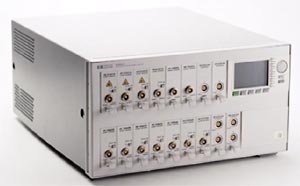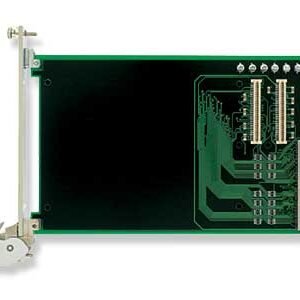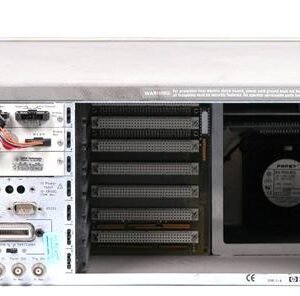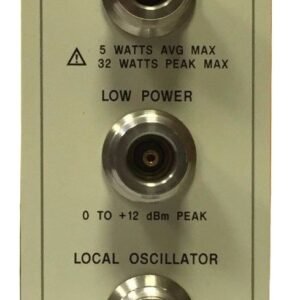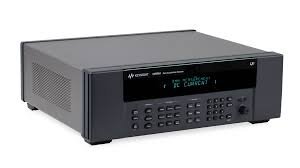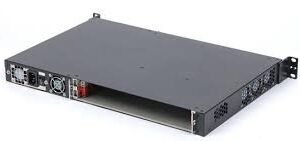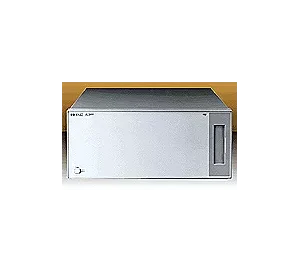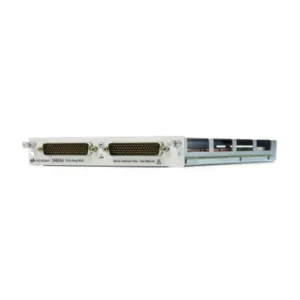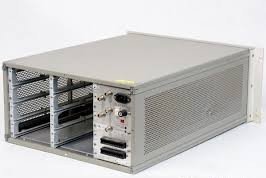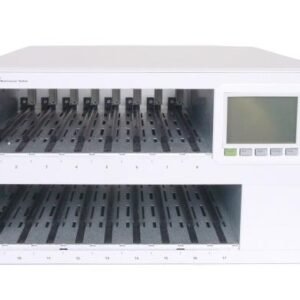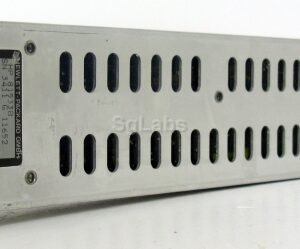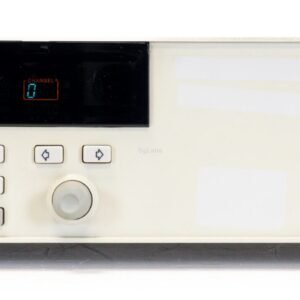

The National Instruments SCXI-2000 is a 4-slot chassis that houses SCXI modules for signal conditioning and data acquisition across measurement and control applications. It delivers a low-noise environment for signal processing while providing module power and control through standard AC input. The chassis accepts both current and future SCXI modules, making it a flexible platform for expanding measurement capabilities without redesigning the host system.
Technical Specifications
• Module Capacity: 4 SCXI modules
• Power Input: Standard AC power with voltage selection wheel on back panel
• Serial Communication: RS-232 and RS-485 ports; default baud rate 9600 bps
• Fuses: Backplane and main fuses
• Weight: 8 lb 8 oz
– Key Features
• Low-noise chassis design optimized for signal conditioning
• Front panel status LEDs for chassis activity monitoring
• DIP switches for chassis address and baud rate configuration
• RS-232 connector and reset button on front panel
• Power switch with indicator light
• Front and back threaded strips for secure mounting
• Fan and filter assembly on back panel
• Module guides and backplane for stable slot alignment
– Typical Applications
The SCXI-2000 supports a wide range of signal types through compatible module accessories:
• Thermocouple and RTD measurement
• Strain gauge acquisition
• High-voltage signal input
• Analog output and waveform generation
• Digital I/O operations
• Current input measurement
• Signal amplification, filtering, isolation, and multiplexing
– Compatibility & Integration
The chassis integrates with National Instruments’ ecosystem through NI-DAQ driver software, which provides libraries for analog input, buffered data acquisition, analog output, waveform generation, digital I/O, counter/timer operations, SCXI module control, RTSI synchronization, and self-calibration. Compatible programming environments include LabVIEW, LabWindows/CVI, and Measurement Studio.
Multiple part numbers accommodate different configurations: 183039J-01 (standard assembly) and 183039J-31 (240 VAC assembly). Optional cables and terminal blocks with screw terminals, BNC connectors, or thermocouple plugs enable flexible signal routing to acquisition modules.