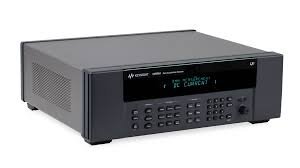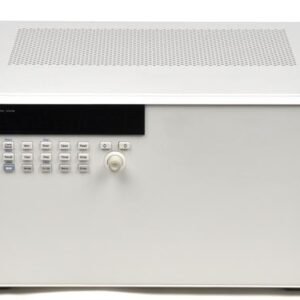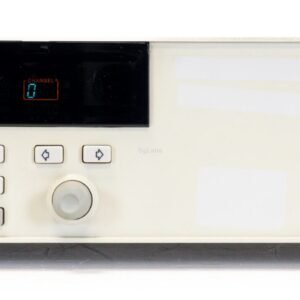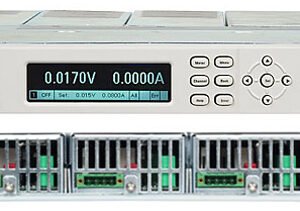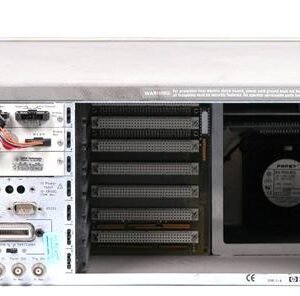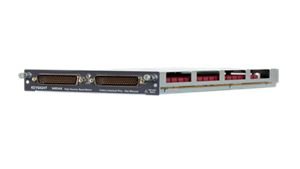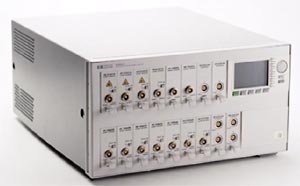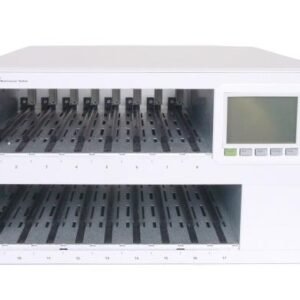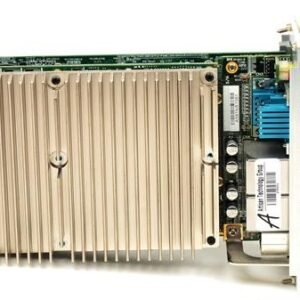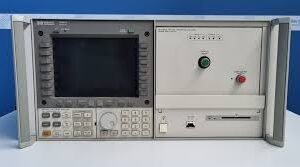

The Newport 8200 is a 2-channel modular mainframe designed for precision testing and characterization of photonic devices and components. It serves research, development, and manufacturing applications requiring stable, versatile optical measurements. The system houses the power supply, central processor, and communication functions within a benchtop or rack-mounted chassis. Its plug-and-play architecture recognizes inserted modules automatically upon power-up, enabling flexible test configurations with interchangeable optical instruments. Multiple systems can be interconnected to scale channel density for larger measurement tasks.
Technical Specifications
• Channels: 2-channel configuration
• Plug-in Bays: 2 slots for interchangeable modules
• Display: Backlit LCD graphical display
• Module Auto-Detection: Recognizes inserted modules at power-up
• Power Input: 100 V AC to 240 V AC, 50/60 Hz, 2.5 A max
• Modulation: Sync or On/Off capability at standard test tones (270 Hz, 1 kHz, 2 kHz) in constant I or P mode
– Key Features
• Soft-key Menu Control: Internal addressable menu structure for onboard operation
• Remote Interfaces: GPIB/IEEE-488, RS-232C (9-pin male D-sub), and USB connectivity
• Synchronization: Central sync signal generation with external sync input via BNC connector; supports inter-module timing coordination
• Module Compatibility: Accepts stabilized light sources, optical power meters, optical attenuators, and optical switches with plug-and-play recognition
• Configuration Options: Fold-out legs for benchtop use; optional rack mount kits available
– Typical Applications
• DWDM parameter testing and validation
• Long-term laser diode stability characterization
• Fiber optic power and wavelength measurements
• Photonic component research and development
– Compatibility & Integration
The 8200 accommodates Newport’s photonic test modules, including fiber optic wavelength meters (±15 ppm absolute accuracy via Michelson interferometer) and fiber optic power meters with wavelength range 400–1800 nm and power measurement from −100 dBm to +3 dBm. A 37-pin D-sub bus extender enables system expansion. Single and dual-channel module variants support diverse measurement architectures.