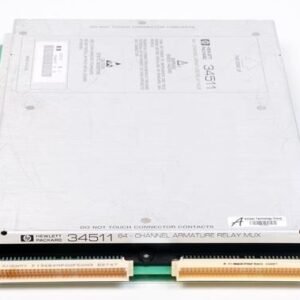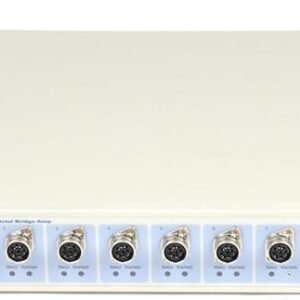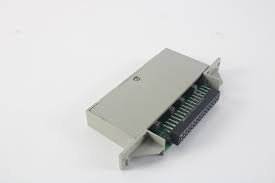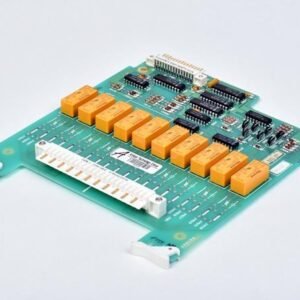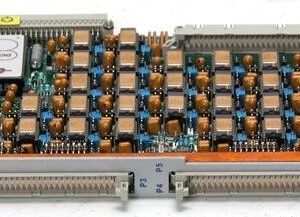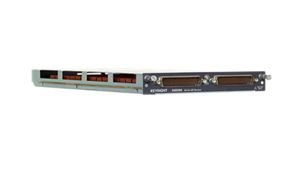

The NI SCXI-1127 is a high-voltage electromechanical relay multiplexer/matrix switch module engineered for SCXI chassis-based data acquisition systems. It delivers flexible switching configurations—64×1 single-wire, 32×1 two-wire, 16×1 four-wire, or 4×8 two-wire matrix—with expansion capability for larger topologies. The module combines high voltage capacity up to 300 V with low thermal offset and contact resistance, making it suitable for precision low-voltage measurements and high-voltage signal routing in industrial and laboratory environments.
Technical Specifications
• Switching Capacity: 300 VDC or AC peak (channel-to-ground); 250 Vrms at 200 mA load; 30 VDC at 1 A load
• Maximum Switching Power: 30 W, 60 VA
• Channel Count: 64 channels (1-wire mode); reconfigurable via topology selection
• Isolation: 2300 Vrms between input signals and backplane (1 minute dielectric withstand)
• Path Resistance: Typically low throughout relay life; exceeds 2 Ω at end of life
• Bandwidth: 11 MHz maximum
• Switching Speed: 100 operations/s
• Contact Resistance: Low, optimized for RTD and low-resistance measurements
• Safety Rating: Measurement Category II; rated for signal voltages ≤300 V
– Key Features
• Software-selectable scanning with arbitrary channel sequencing
• Hardware-timed scanning via digital trigger signals for synchronous or handshaking operation
• Support for DC, ACrms, and mixed input modes within single scan sequences
• Extremely low thermal offset for precision analog measurements
• Hazardous voltage isolation prevents mixing high-voltage (>42.4 Vpk/60 VDC) and safety low-voltage (≤42.4 Vpk/60 VDC) on separate relay terminals
– Typical Applications
Multi-channel switching of low and high-voltage signals; precision RTD and resistance measurement; multi-sensor data acquisition; arbitrary waveform signal routing; industrial process monitoring.
– Compatibility & Integration
Driver support via NI-SWITCH software. Compatible with LabVIEW, Measurement Studio, Visual Basic, Microsoft C, and C++. Integrates with external measurement devices through synchronous or handshaking digital trigger protocols.