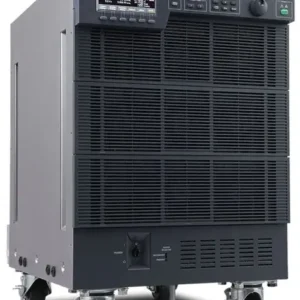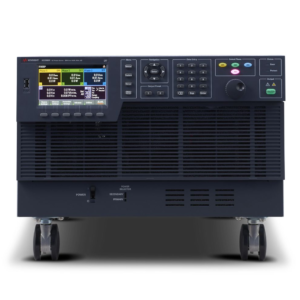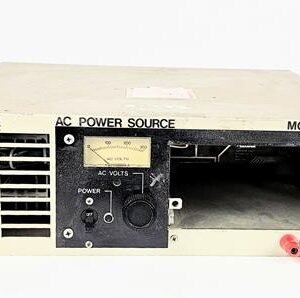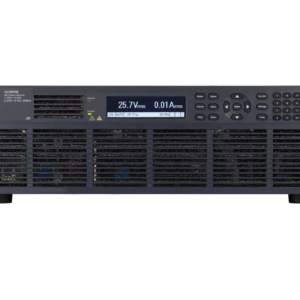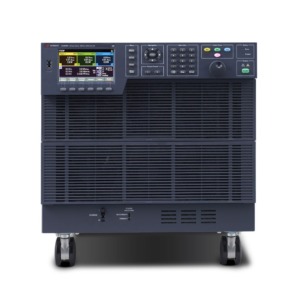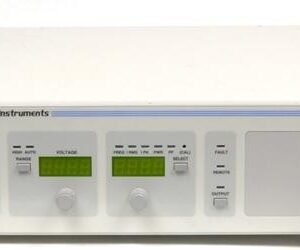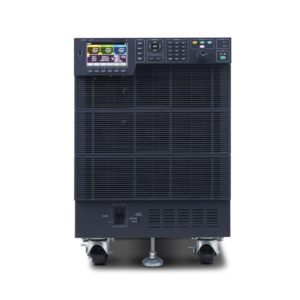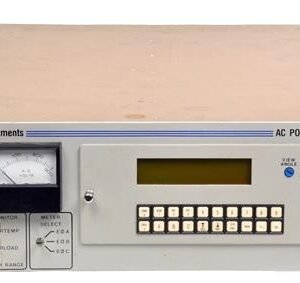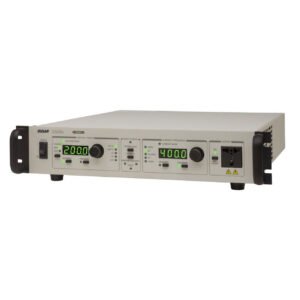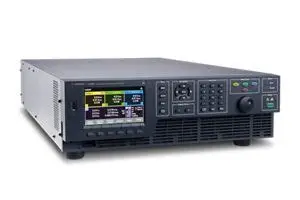
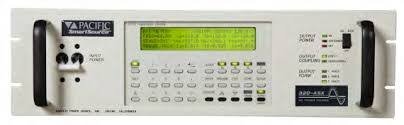

The Pacific Power 320ASX-UPC3/G is a programmable AC power source delivering 2 kVA rated power for demanding test, simulation, and compliance applications. Operating from single-phase 240 VAC input (208 VAC available on request), it generates output up to 300 V with selectable single-phase or three-phase configuration. The unit combines high-frequency pulse width modulation for efficient operation with quartz-crystal stabilized frequency control and TRUE-RMS metering across voltage, current, and power parameters.
Technical Specifications
• Rated Power: 2000 VA (2 kVA)
• Input: Single-phase, 240 VAC, 47–63 Hz (208 VAC on request)
• Output Voltage: Up to 300 V (150/300 Vrms L-N/L-L)
• Output Current: 20 A / 12 A single-phase; 7 A per phase three-phase
• Output Frequency: 15 Hz to 1200 Hz, quartz-crystal stabilized; 5000 Hz small-signal bandwidth
• Phase Configuration: Single or three-phase output, switch selectable from front panel or bus command
• Line Regulation: 0.1% max (±10% line variation)
• Load Regulation: 0.25% (15–400 Hz); 0.50% (400–1200 Hz); improves to <0.1% with external sense and Continuous Self Calibration (CSC) enabled
• Output THD: 0.25% (15–200 Hz); 0.50% (200–1200 Hz)
• Load Transient Response: 60 microseconds typical (10–90% load step)
• Short-term Overload: Up to 30 A permitted (line and temperature dependent)
– Key Features
• Continuous Self Calibration (CSC) for precision voltage programming to 0.05%
• Full current delivery to low power-factor loads without derating
• 22-waveform library with arbitrary waveform generation and harmonic synthesis
• Harmonic analysis of voltage and current
• 99 stored programs for static and dynamic transient testing
• Programmable output impedance
• TRUE-RMS metering of RMS and peak values
– Control & Integration
• UPC-3 programmable controller with UPC Studio graphical interface
• UPC Studio Software Suite, UPC Interactive LabVIEW™ Libraries, and UPC Test Manager
• RS-232 (SCPI) and GPIB (IEEE-488.2) interfaces
– Typical Applications
Product development, compliance testing, quality control, and transient simulation requiring programmable AC voltage and frequency across industrial and aerospace test environments.