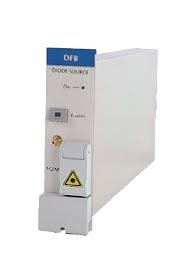

The Photonetics Osics DFB-1550.92-P13 is a Distributed Feedback laser diode module engineered for single-frequency, continuous-wave operation at 1550.92 nm (193.30 THz). This 14-pin butterfly package delivers a narrow linewidth of typically 1 MHz with minimum 30 dB side-mode suppression ratio, making it ideal for precision optical systems. An integrated back-facet monitor photodiode enables real-time power monitoring, while integrated thermoelectric cooling and thermistor sensing provide precise wavelength control and stability. Temperature tuning enables alignment to ITU DWDM frequencies across a typical ±1.5 nm range with ±1 nm accuracy.
Technical Specifications
Optical Performance
• Wavelength: 1550.92 nm (193.30 THz)
• Linewidth: Typically 1 MHz
• Side-Mode Suppression Ratio: Minimum 30 dB
• Relative Intensity Noise: Maximum −145 dB/Hz
• Wavelength Tuning Range: Typically ±1.5 nm
• Wavelength Accuracy: ±1 nm
• Temperature Coefficient: Approximately 0.1 nm/°C
Laser Diode Electrical
• Forward Voltage: 2.5 V (typ.)
• Operating Current (Max.): 300 mA
• Threshold Current: 25 mA (typ.)
Monitor Photodiode
• Monitor Current Range: 0.10 mA to 1.0 mA
• Dark Current: 2 nA (typ.), 100 nA (max.)
Thermal Management
• TEC Voltage (Max.): 2.4 V
• TEC Current (Max.): 1.0 A
• Thermistor Resistance: 7.7 kΩ to 12.6 kΩ
• Thermistor B Constant: 3,270 K to 3,630 K
– Key Features
• Single-mode fiber pigtail with FC/APC connector
• Integrated thermoelectric cooler for precise wavelength control
• Built-in temperature monitoring via thermistor
• Real-time optical power monitoring
• Continuous-wave operation
• Polarization-maintaining output available
– Typical Applications
• Dense Wavelength Division Multiplexing (DWDM)
• Telecommunications
• Optical sensing systems
• Metrology and precision measurements
• RF over Fiber (RFoF)
• Hybrid Fiber-Coaxial (HFC) systems
• Laboratory and research applications
– Compatibility & Integration
The standard 14-pin butterfly package with single-mode fiber pigtail and FC/APC termination integrates into OEM optical systems and test equipment platforms. Temperature-tuning capability enables alignment to ITU grid frequencies for DWDM deployments.