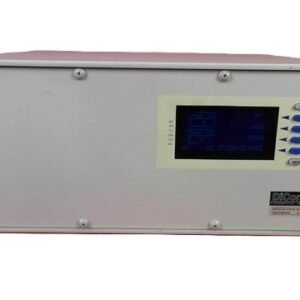
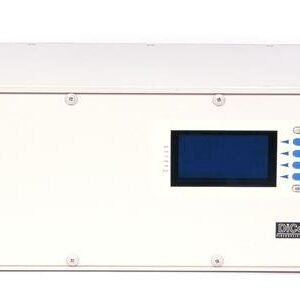
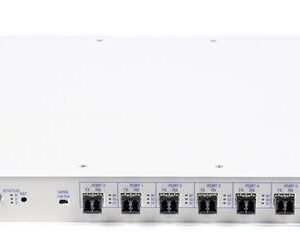
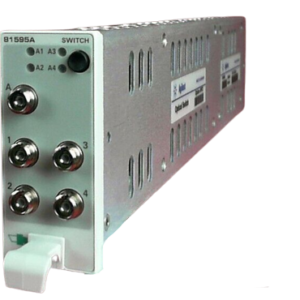
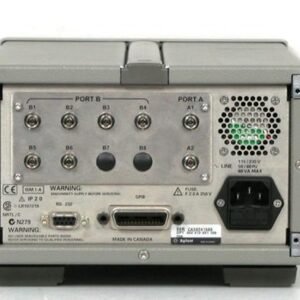
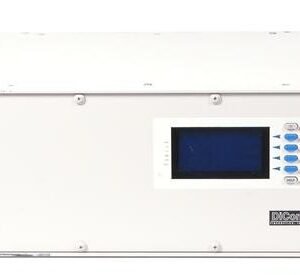
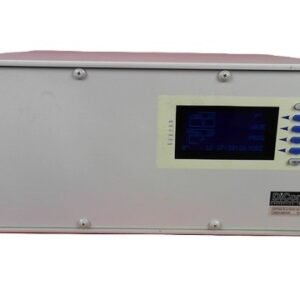
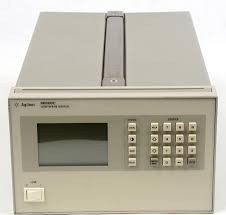
The Polatis I-OST-12×12-LU1-MTANS is a 12×12 non-blocking all-optical matrix switch employing patented DirectLight® beam-steering technology for precision optical routing. The system aligns collimated light beams between input and output fibers to achieve minimal insertion loss, distortion, and inter-path interference. Single-mode fiber connections support wavelengths from 1260 to 1625 nm with protocol and bit-rate independence, enabling operation across lit and dark fiber deployments. Switching occurs in under 17 ms per channel with insertion loss below 1.0 dB, return loss exceeding 55 dB, and crosstalk rejection better than −70 dB. The switch handles optical power levels to +27 dBm and maintains high repeatability and signal stability across a wide spectral range. Control interfaces include Ethernet and RS232 ports supporting SCPI, TL1, and SNMP protocols. The system mounts in standard 19″ rack enclosures.
Technical Specifications
• Port Configuration: 12×12 symmetric, fully non-blocking
• Switching Technology: DirectLight® beam-steering (patented)
• Fiber Type: Single-mode 9/125 µm
• Wavelength Range: 1260–1625 nm
• Switching Speed: <17 ms (single-channel increment)
• Insertion Loss: 55 dB
• Crosstalk Isolation: <−70 dB
• Maximum Optical Power: +27 dBm
• Polarization Dependent Loss: Low PDL
• Fiber Connector: LC/UPC rear bulkheads
• Control Ports: Ethernet, RS232
• Supported Protocols: SCPI, TL1, SNMP
– Key Features
• Bi-directional traffic support with independent lit/dark fiber operation
• High repeatability and signal stability across the extended wavelength band
• Web-based GUI and network management tools for dynamic provisioning
• Rack-mount form factor (19" standard enclosure)
– Typical Applications
• Network-level fiber routing and IP-over-optical switching
• Automated test sequence execution and design verification
• Manufacturing test systems and quality assurance
• High-power laser switching and secure communication networks
• Fiber-layer monitoring and client-side optical switching
– Compatibility & Integration
The switch operates independently of data protocol and bit rate. Management via standard Ethernet or serial interfaces enables integration into existing network operations platforms and automated test frameworks.