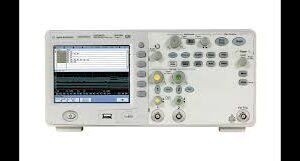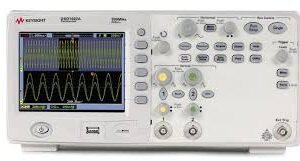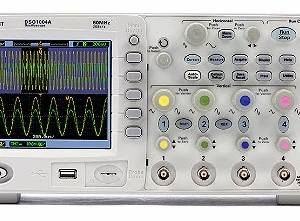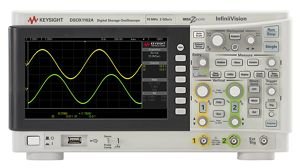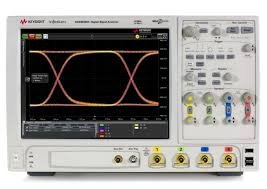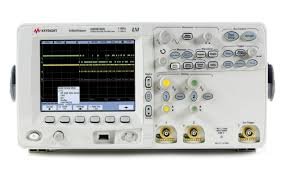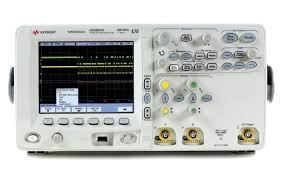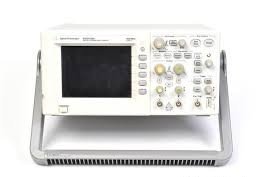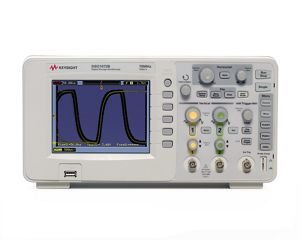
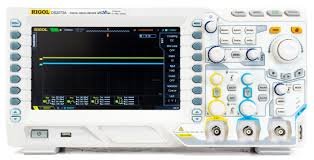

The Rigol DS2072A is a 2-channel, 70 MHz digital storage oscilloscope engineered for signal acquisition and analysis across development, troubleshooting, and production environments. It samples at up to 2 GSa/s with 14 Mpts standard memory (expandable to 56 Mpts) and captures waveforms at rates up to 50,000 wfms/s using UltraVision technology. The 8-inch WVGA color TFT display (800×480 pixels, 256 intensity levels) delivers clear signal visualization across a vertical range of 500 µV/div to 10 V/div. A low noise floor and dual input impedance (1 MΩ / 50 Ω) make it suitable for precision small-signal measurements. Time base spans 5 ns/div to 50 s/div. The oscilloscope includes runt triggering, versatile trigger functions, and optional serial bus triggering and decoding for RS232, I²C, SPI, and CAN protocols. Hardware-based waveform recording stores up to 65,000 frames for real-time playback and analysis. Maximum input voltage is 300 V across AC, DC, and GND coupling modes.
Technical Specifications
• Bandwidth: 70 MHz
• Channels: 2 analog channels
• Sample Rate: 2 GSa/s maximum
• Memory Depth: 14 Mpts (standard); 56 Mpts (optional)
• Waveform Capture Rate: Up to 50,000 wfms/s
• Display: 8-inch WVGA color TFT, 800×480 pixels, 256 intensity levels
• Vertical Range: 500 µV/div to 10 V/div
• Input Impedance: 1 MΩ / 50 Ω selectable
• Input Coupling: AC, DC, GND
• Maximum Input Voltage: 300 V
• Time Base: 5 ns/div to 50 s/div
• Waveform Recording: Up to 65,000 frames (hardware-based real-time)
• Power Supply: 115 V/AC or 230 V/AC
• Dimensions: 362 mm (W) × 179 mm (H) × 130 mm (D)
• Weight: 3.9 kg
– Key Features
• UltraVision technology for high-speed waveform capture
• Runt triggering and comprehensive trigger functions
• Optional serial bus triggering and decoding: RS232, I²C, SPI, CAN
• Real-time waveform record, replay, and analysis
• Dual input impedance modes for flexible signal coupling
• Low noise floor for small-signal fidelity
– Connectivity & Integration
• USB Host and USB Device ports
• LAN (LXI) interface
• AUX connector
– Typical Applications
Product development, circuit debugging, signal characterization, embedded system validation, protocol analysis (with optional decode modules), and production test.