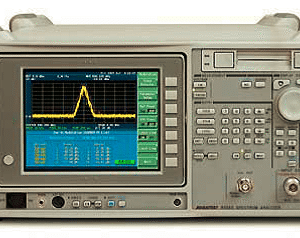
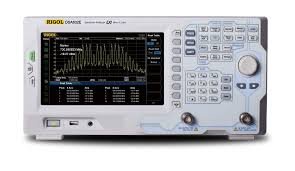

The Rigol DSA832E is a 3.2 GHz spectrum analyzer engineered for RF signal characterization and measurement across demanding applications. Built on all-digital IF technology, it delivers enhanced reliability and measurement fidelity. The instrument combines high sensitivity—down to -161 dBm typical with preamplifier enabled—with 1 Hz frequency resolution and broad span capabilities from 100 Hz to 3.2 GHz, making it suitable for component testing, interference analysis, and wideband signal assessment.
Technical Specifications
Frequency Performance
• Operating range: 9 kHz to 3.2 GHz
• Frequency resolution: 1 Hz
• Reference frequency: 10 MHz
• Reference frequency accuracy: ±1 ppm initial calibration; ±1 ppm temperature stability (0°C to 50°C, 25°C ref); ±2 ppm/year aging
• Frequency span: 100 Hz to 3.2 GHz
• Resolution bandwidth: 10 Hz to 1 MHz in 1-3-10 sequence
Amplitude Characteristics
• Displayed average noise level (DANL) with preamplifier: down to -161 dBm typical (3.2 GHz models)
• With preamplifier off: -120 dBm typical (9–100 kHz), -135 dBm typical (100 kHz–5 MHz), -144 dBm typical (5 MHz–1.5 GHz), -140 dBm typical (1.5–3.2 GHz)
• With preamplifier on: -155 dBm typical (100 kHz–5 MHz), -161 dBm typical (5 MHz–1.5 GHz), -157 dBm typical (1.5–3.2 GHz)
• SSB phase noise: <-90 dBc/Hz at 10 kHz offset (typical, fc=1 GHz, 20–30°C)
• Absolute amplitude uncertainty: <0.3 dB (fc=50 MHz, peak detector, preamplifier off, attenuation 10 dB, input signal -10 dBm, 20–30°C)
• Level measurement uncertainty: <1.0 dB; <0.8 dB nominal (95% confidence)
• Second harmonic intercept: +40 dBm (fc≥50 MHz, -20 dBm input, attenuation 10 dB)
• Third-order intercept: +7 dBm (fc≥50 MHz, dual -20 dBm tones spaced 200 kHz, attenuation 10 dB)
– Key Features
• 8-inch WVGA display (800×480 resolution) for clear signal visualization
• Auto Tune, Auto Range, Auto Scale, Auto Couple for rapid signal acquisition
• Frequency counter resolution down to 1 Hz
• 10 MHz reference for calibration and traceability
– Typical Applications
Component characterization, signal identification, interference detection, spectrum monitoring, EMI/RFI assessment.
– Compatibility & Integration
Standard RF input connector configuration supports direct integration into test benches and automated measurement systems.