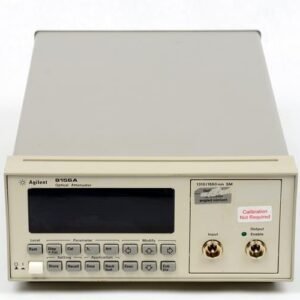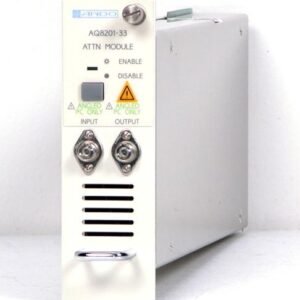

The Santec OTF-920 is a programmable optical tunable filter that enables precise wavelength selection and control across the C-band and L-band regions. It employs multilayer dielectric interference filters combined with Santec’s patented linear sliding tuning method to deliver wide tuning range with stable optical properties throughout. The instrument supports dual-slider configurations, allowing independent operation of two optical elements—each configured as a bandpass filter or variable attenuator—to enable continuous 80 nm tuning, segmented 40 nm tuning across separate bands, or simultaneous wavelength and power control.
Technical Specifications
• Tuning Range: 1530–1610 nm (overall); 1530–1570 nm (Slider 1); 1570–1610 nm (Slider 2)
• Wavelength Resolution: 0.01 nm
• Wavelength Accuracy: < ±0.1 nm
• Wavelength Repeatability: < ±0.05 nm
• Input Power: 45 dB
• Polarization Mode Dispersion (PMD): < 0.1 ps
• Polarization Dependent Loss (PDL): < 0.1 dB (SMF); < 0.2 dB (SMF)
• Bandwidth (−3 dB): 0.65–0.95 nm (typical); dual-filter combinations up to 2.0 nm typical
• Bandwidth (−20 dB): < 3.0–9.8 nm (typical)
• Insertion Loss: < 3.5–5.5 dB maximum
• Connector: FC/SPC (front)
– Key Features
• Linear sliding tuning technology maintains constant bandwidth, insertion loss, and PDL across the entire tuning range
• Dual-slider architecture enables flexible optical configurations: dual bandpass filters, filter plus attenuator, or dual attenuators
• Automatic peak search function identifies and locks to maximum power within a user-specified wavelength window
• Optional Automatic Power Control (APC) stabilizes output power at a target level
• Programmable filter profiles accommodate application-specific requirements
– Typical Applications
• Optical fiber communication systems testing and component characterization
• Spectroscopy and wavelength-dependent measurements
• Optical sensing and monitoring
• ASE noise filtering to enhance signal-to-noise ratio in amplified systems
• Tunable incoherent light source generation when paired with broadband optical sources
– Compatibility & Integration
Remote control via GPIB and RS-232C interfaces enables integration into automated test systems and laboratory setups.