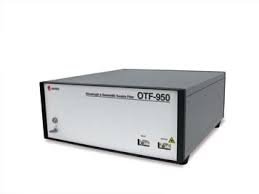

The Santec OTF-950 is a bench-top tunable optical filter engineered for precision wavelength selection in optical communication and measurement systems. It delivers independent, simultaneous control of wavelength tuning and passband width across the C-band and extended infrared range. The instrument employs free-space optics and precision tuning mechanics to achieve flat-top passband characteristics with excellent optical control. A 40 nm tuning range and wavelength accuracy of ±0.02 nm enable reliable channel selection and spectral analysis. The OTF-950 interfaces via USB with LabVIEW software support and GPIB for remote operation, accommodating both manual and automated wavelength and bandwidth configuration. Insertion loss of approximately 5 dB with 0.5 dB uniformity, combined with low PDL (≤ 0.25 dB) and PMD (≤ 0.2 ps), ensures minimal signal degradation across polarization states. Return loss exceeds 45 dB. Though Santec has discontinued manufacturer support, the OTF-950 remains operational for legacy installations and applications requiring flexible optical filtering.
Technical Specifications
• Wavelength Range (C-Band): 1525–1565 nm
• Wavelength Range (Extended): 1530–1610 nm
• Wavelength Tuning Range: 40 nm
• Wavelength Accuracy: ±0.02 nm
• Passband Shape: Flat-top
• Bandwidth Tuning Range (−3 dB): 0.25 nm to 6.0 nm
• Bandwidth Tuning Range (−20 dB): 0.25 nm to 6.0 nm
• Bandwidth Tuning Range (Notch Type): 0.4 nm to 6.0 nm
• Insertion Loss: Typically 5 dB
• Insertion Loss Uniformity: 0.5 dB
• Polarization Dependent Loss (PDL): ≤ 0.25 dB
• Polarization Mode Dispersion (PMD): ≤ 0.2 ps
• Chromatic Dispersion: −40 to 40 ps/nm
• Return Loss: ≥ 45 dB
• Supply Voltage: AC 100–240 V (±10%)
• Frequency: 50/60 Hz
• Dimensions: 343 × 376 × 133 mm
– Key Features
• Independent wavelength and passband width tuning
• Free-space optical architecture for precision control
• USB interface with LabVIEW software; GPIB remote control
• Flat-top passband design for sharp spectral response
• Low-loss, polarization-insensitive performance
– Typical Applications
• 40 Gb/s and 100 Gb/s transmission testing
• DWDM channel selection and isolation
• ASE noise filtering in amplified systems
• Optical spectrum analysis
• Fiber optic sensing
• Optical wavelength cross-connect (OXC) systems
• Pulse shaping
• Incoherent light source generation with broadband sources
– Compatibility & Integration
USB and GPIB interfaces support both manual and automated operation. LabVIEW software enables programmatic control for test automation and wavelength scanning protocols.