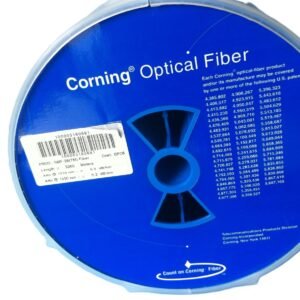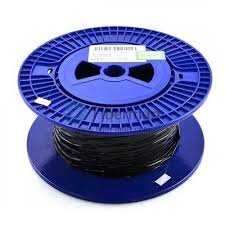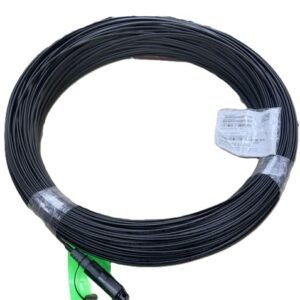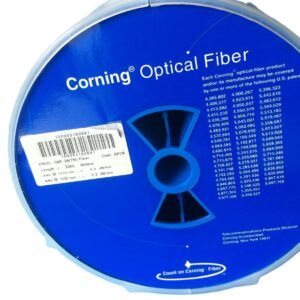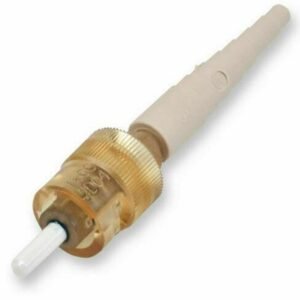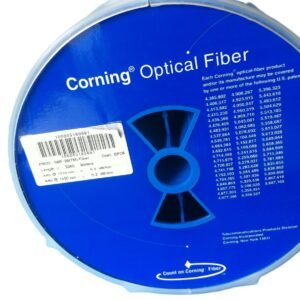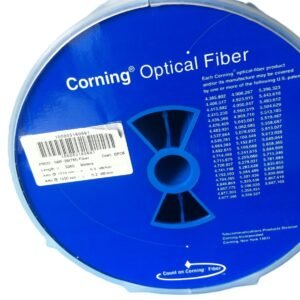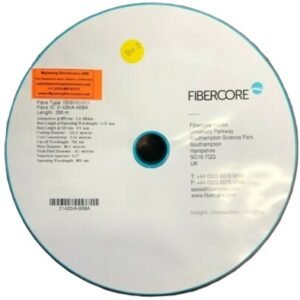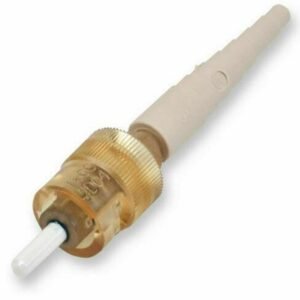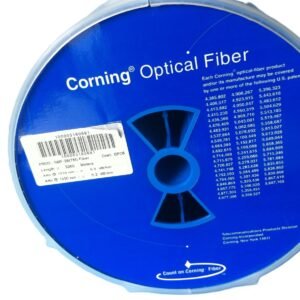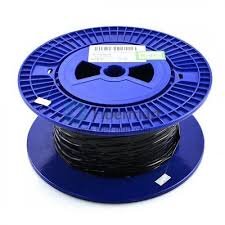

This 25 km spool of Corning SMF-28 Ultra single-mode optical fiber delivers low-loss transmission across the C, L, and O bands. Terminated with SC connectors, the bare fiber configuration provides direct integration into telecommunications, data center, and enterprise network infrastructures. SMF-28 Ultra exceeds ITU-T G.657.A1 macrobend performance while maintaining full G.652.D compliance, enabling backward compatibility with installed single-mode fiber systems.
Technical Specifications
Fiber Characteristics
• Standard: Corning SMF-28 Ultra, single-mode all-glass construction
• Compliance: ITU-T G.652.D, ITU-T G.657.A1 (exceeds recommendations)
• Cable cutoff wavelength (λcc): ≤1260 nm
• Numerical aperture: 0.14
Attenuation Performance
• 1310 nm: ≤0.32 dB/km
• 1490 nm: ≤0.21 dB/km
• 1550 nm: ≤0.18 dB/km
• 1625 nm: ≤0.20 dB/km
• Post-hydrogen aging (1383 nm): ≤0.32 dB/km
Dispersion
• Zero dispersion wavelength: 1304–1324 nm
• Zero dispersion slope: ≤0.092 ps/(nm²·km)
• Dispersion @ 1550 nm: ≤18.0 ps/(nm·km)
• PMD link design value: ≤0.04 ps/√km
Mode Field Diameter
• @ 1310 nm: 9.2 µm ± 0.4 µm
• @ 1550 nm: 10.4 µm ± 0.5 µm or 10.7 µm ± 0.5 µm
Macrobend Loss
• 10 mm mandrel, 1 turn @ 1550 nm: ≤0.50 dB
• 15 mm mandrel, 10 turns @ 1550 nm: ≤0.05 dB
• 30 mm mandrel, 100 turns @ 1625 nm: ≤0.1 dB
– Key Features
• Rayleigh backscatter: -77 dB @ 1310 nm; -82 dB @ 1550 nm
• Point discontinuity: ≤0.05 dB at 1310 nm and 1550 nm
• SC connectors with blue boot, UPC style ferrule (126 ± 0.5 µm internal)
• Insertion loss: typically 50 dB
• Mating cycles: up to 1000
• Operating temperature: -40°C to +85°C
• IEC 61754-20 compliant
– Typical Applications
Telecommunications backbone networks, long-haul data transmission, metropolitan area networks, and enterprise fiber installations requiring low attenuation and dispersion-managed performance across multiple wavelengths.
– Compatibility & Integration
Full backward compatibility with existing G.652.D infrastructure. SC connectors support both single-mode and multi-mode applications with standardized interfaces for network equipment integration.