The Stanford Research Systems DG535 is a four-channel digital delay generator engineered for applications demanding precise timing and ultra-low jitter. It generates four independent delay outputs (A, B, C, D) and two independent pulse outputs (AB, -AB, CD, -CD) with delay ranges from 0 to 999.999,999,999,995 seconds and 5 ps resolution. Channel-to-channel jitter is typically 50 ps RMS, while RMS jitter from external trigger to any output is less than 100 ps + (10⁻⁸ × delay). The instrument supports internal trigger rates from 1 mHz to 1 MHz, external triggering, single-shot and burst modes, and AC line synchronization. Output impedance is selectable (50 Ω or high impedance) with TTL, ECL, NIM, or variable output levels. Front-panel BNC connectors deliver rise times of 2 to 3 ns and fall times of 100 ps maximum. An optional ±32 V output module (Option 02) provides rear-panel outputs at 1 kHz repetition rate. The standard timebase uses a 25 ppm crystal oscillator; an optional 1 ppm TCXO (Option 03) is available. External 10.0 MHz reference input is supported. Designed for laser synchronization, high-speed data acquisition, and automated testing environments demanding timing accuracy and reliability.
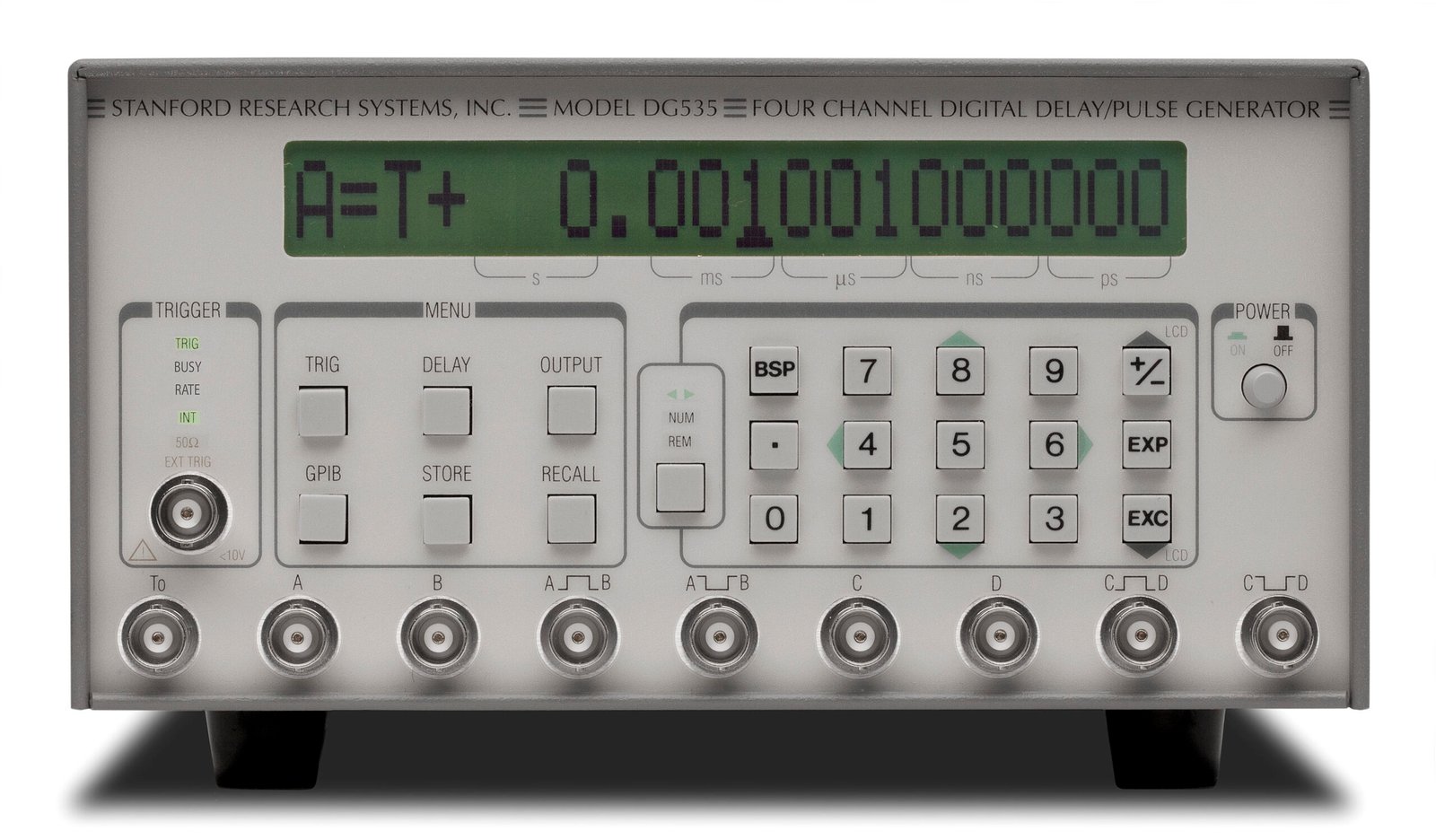
Stanford Research DG535 – Four Channel Digital Delay Generator
Brand: Stanford Research Systems
30 Days Warranty30 Days Free Returns >- Repair Support & OEM Spare Parts
- University and Research Discounts
- Rental Units Available
The Stanford Research Systems DG535 is a versatile four-channel digital delay generator. It offers precise and programmable delays with low jitter, making it suitable for timing-critical experiments and applications.
Product Starting From:
$1,750.00
In stock
In stock

FedEx, UPS, USPS
Shipping world-wide available:
DHS, FedEx International
Request Quick Quote DG535
| MPN | DG535 |
|---|---|
| Frequency Range | 1 mHz to 1 MHz (internal trigger rate) |
| Voltage / Current Range | -3 V to +4 V (variable outputs); TTL 0 to 4 VDC; ECL -1.8 to -0.8 VDC; NIM -0.8 to 0.0 VDC |
| Brand Name | Stanford Research Systems |
You May Also Like
-

Brandywine PCI-SyncClock32 Timing Module
$1,450.00 Add to Cart -
Agilent / Keysight E1725C Time Interval Analyzer
$6,622.00 Add to Cart -

Agilent/Keysight 70874D – Digitizing Oscilloscope Module
$79.00 Add to Cart -
Agilent/Keysight N1076B
$15,900.00 Add to Cart -
Agilent/Keysight N4880A
$4,590.00 Add to Cart -

HP / Agilent 5371A Frequency and Time Interval Analyzer
$383.38 Add to Cart -
Agilent/Keysight 70874C – Digitizing Oscilloscope Module
$79.00 Add to Cart -
Meinberg TCR511PCI IRIG Time Code Receiver
$0.00 Add to Cart -
Microchip / Datum bc630AT Real Time Clock Module
$0.00 Add to Cart -

Anritsu MU181800B – Clock Distribution Module; 14 GHz
$5,200.00 Add to Cart -
Microchip / Datum bc635VME-C Time and Frequency Processor
$0.00 Add to Cart -

HP / Agilent 58503B GPS Time & Frequency Reference Receiver
$1,243.60 Add to Cart -
Agilent / Keysight 86107A Precision Timebase Reference Module
$24,271.90 Add to Cart -

E-MU EM8830 Sync Daughter Card
$125.00 Add to Cart -

Agilent/Keysight 83487A Lightwave Clock Recovery Module
$3,019.00 Add to Cart -

Galleon NTS-4000-GPS-R Stand Alone NTP Time Server
$1,100.00 Add to Cart