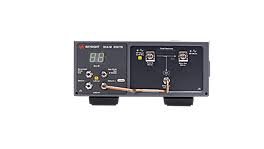
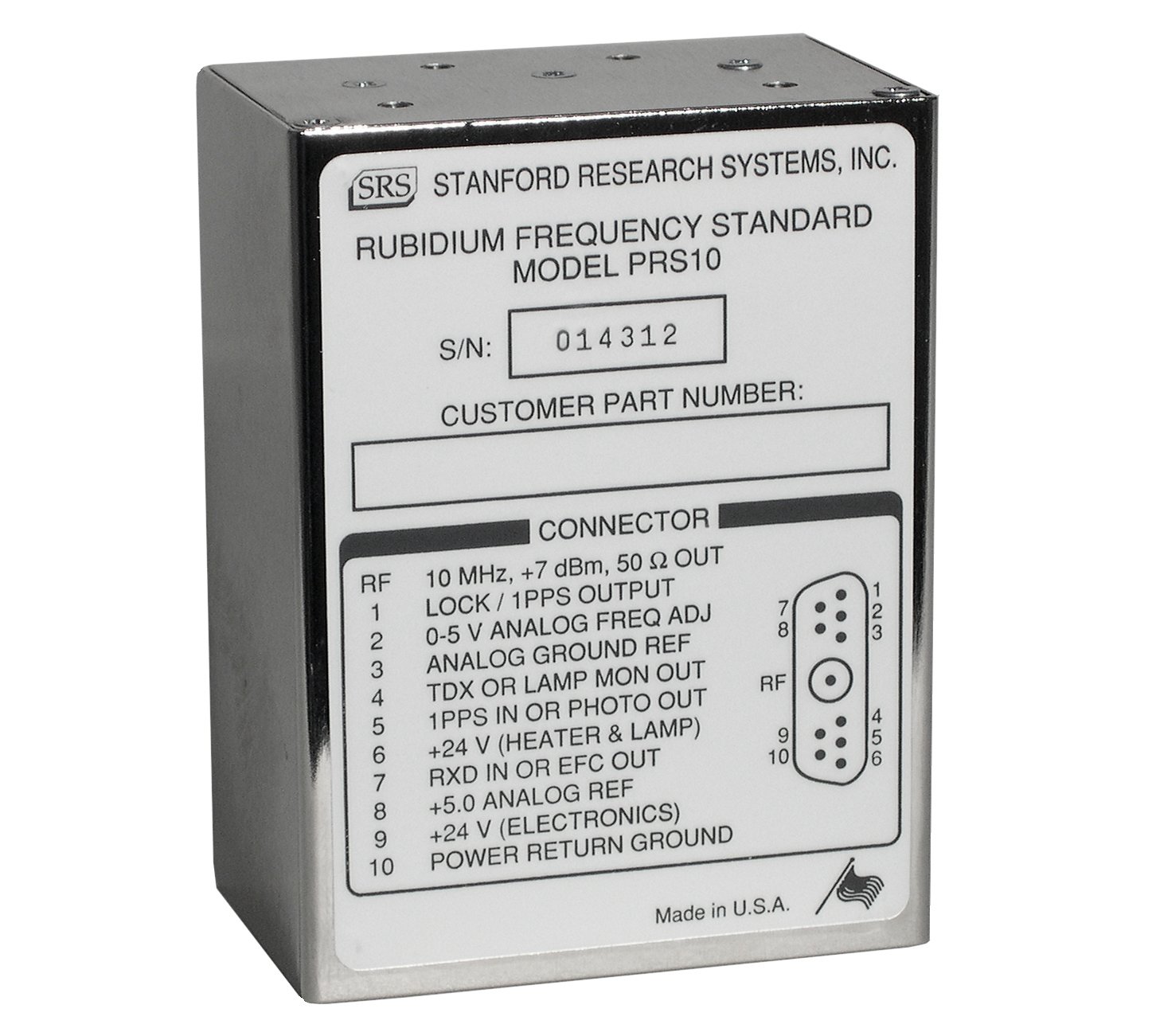

The Stanford Research Systems PRS10 is a high-performance rubidium frequency standard that delivers a 10 MHz sine wave output for precision synchronization and instrumentation applications. Built for environments where frequency stability and low phase noise are critical, the PRS10 achieves phase noise below –130 dBc/Hz at 10 Hz offset and maintains short-term stability of 2 × 10⁻¹¹ at 1 second. The unit operates from +22 VDC to +30 VDC and draws 50 W, fitting into compact 2.00″ × 3.00″ × 4.00″ form factor.
Technical Specifications
• Output: 10 MHz sine wave, 0.5 Vrms ±10%
• Phase Noise (SSB): <–130 dBc/Hz @ 10 Hz; <–140 dBc/Hz @ 100 Hz; <–155 dBc/Hz @ 10 kHz
• Spurious Outputs: <–130 dBc (100 kHz BW)
• Harmonic Distortion: <–25 dBc
• Accuracy at Shipment: ±5 × 10⁻¹¹
• Aging (monthly, after 30 days): <5 × 10⁻¹¹; optional C-option reduces to <2.5 × 10⁻¹¹
• Short-Term Stability (Allan Variance): <2 × 10⁻¹¹ @ 1 s; <1 × 10⁻¹¹ @ 10 s; 25 dB return loss
• ±30 VDC protection on all pins except RF output
– Typical Applications
Network synchronization, precision frequency measurement, GPS disciplining, and communication system timing where long-term stability and minimal phase noise are essential.
– Compatibility & Integration
The PRS10 interfaces via RS-232 for system integration and accepts CMOS-level 1 PPS input (100 kΩ impedance) for phase-locking. Standard CMOS 1 PPS output provides synchronization feedback. Operates on +22 VDC to +30 VDC supply.