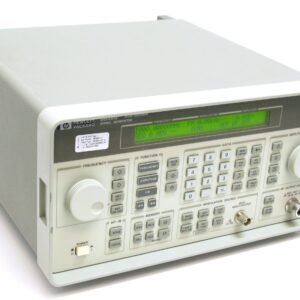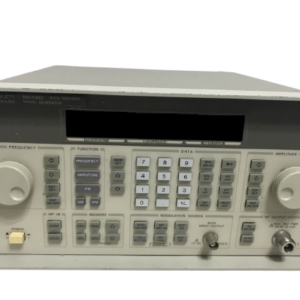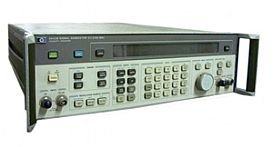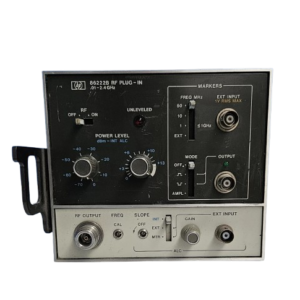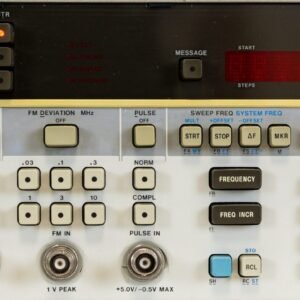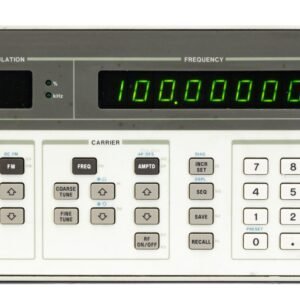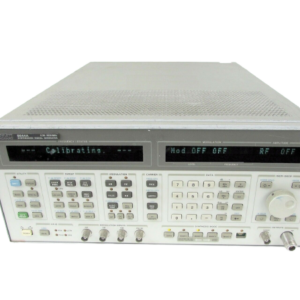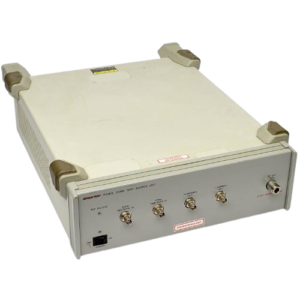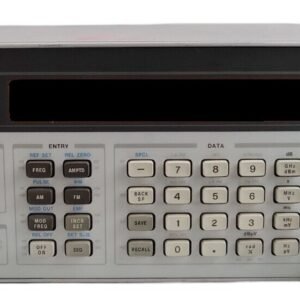
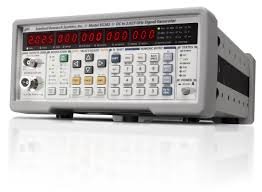

The Stanford Research Systems SG382 is a 2 GHz analog RF signal generator delivering high-resolution frequency synthesis across DC to 2.025 GHz via dual outputs. Built on Rational Approximation Frequency Synthesis architecture, it achieves 1 µHz frequency resolution, -116 dBc/Hz phase noise at 20 kHz offset (1 GHz carrier), and 1 × 10⁻¹¹ frequency stability. The instrument supports six modulation types—AM, FM, ΦM, PM, Pulse, and Blank—with internal waveform sources and external input capability, making it suitable for precision RF characterization and demanding test environments.
Technical Specifications
Frequency Generation
• Frequency range: DC to 62.5 MHz (BNC output); 950 kHz to 2.025 GHz (N-type output)
• Frequency resolution: 1 µHz
• Frequency stability: 1 × 10⁻¹¹ (1 second Allan variance)
• Switching speed: <8 ms to within 1 ppm
Output Characteristics
• BNC output: 1 mVrms to 1 Vrms amplitude, ±1.5 VDC offset, 5 mV offset resolution
• N-type output: +16.5 dBm to -110 dBm power range, 1.60:1 VSWR, 62.5 MHz)
• I/Q modulation option available (400 MHz to 2.025 GHz carrier range, >40 dBc carrier suppression)
Timebase
• Standard: OCXO; optional rubidium timebase available
Interfaces
• Ethernet, GPIB, RS-232
– Key Features
• Dual-output architecture supports low-frequency (DC–62.5 MHz) and RF (950 kHz–2.025 GHz) applications
• Optional low-jitter differential clock outputs
• Benchtop configuration with front-panel control
– Typical Applications
Precision RF testing, phase noise measurement, modulation characterization, and frequency synthesis in research and production environments.
– Compatibility & Integration
Network and legacy instrument control via Ethernet, GPIB, and RS-232 interfaces.