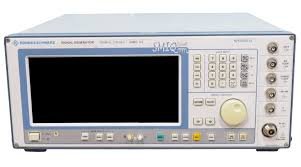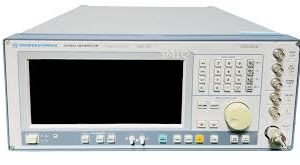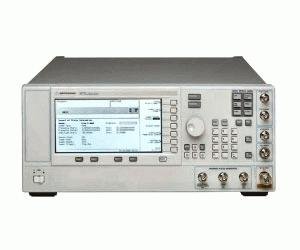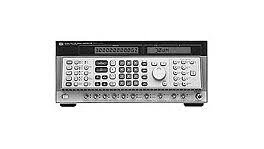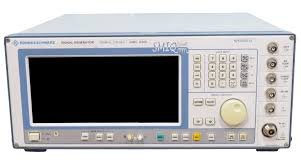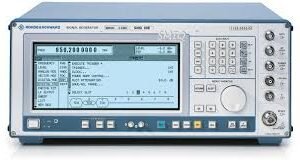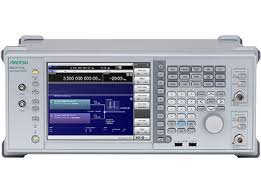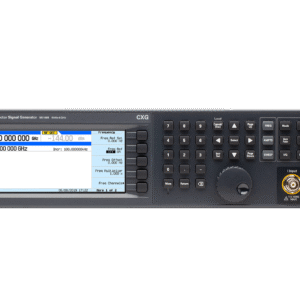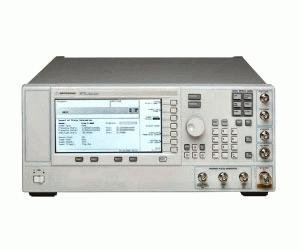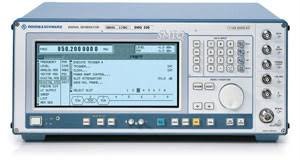
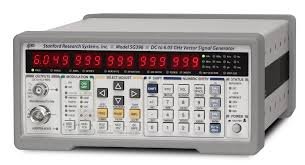

The Stanford Research Systems SG392 is a 2 GHz vector signal generator engineered for RF and microwave component and system testing. It combines analog and vector modulation capabilities using Rational Approximation Frequency Synthesis (RAFS), delivering spur-free outputs with low phase noise and 1 µHz frequency resolution across DC to 2.025 GHz. An ovenized SC-cut oscillator provides superior frequency stability and reduced in-close phase noise versus TCXO-based instruments.
Technical Specifications
Frequency & Output
• Carrier frequency: DC to 2.025 GHz, 1 µHz resolution
• RF output power: +25 dB gain to -130 dB attenuation in 156 digitally controlled steps
• Analog attenuator: 0.01 dB resolution with thermal compensation
• Output connectors: BNC and Type N
Vector Modulation
• Carrier range: 400 MHz to 2.025 GHz
• Modulation bandwidth: 300 MHz
• I/Q inputs: 50 Ω, ±0.5 V rear panel; full-scale (I² + Q²)¹/² = 0.5 V
• Supported modes: BPSK, QPSK, OQPSK, DQPSK, π/4DQPSK, 8 PSK, 16 PSK, 3π/8 8 PSK, QAM (4–256), FSK, ASK, CPM, MSK, VSB (8VSB, 16VSB)
• Internal baseband: Dual 125 MHz arbitrary waveform generators; symbol rates to 6 MHz with programmable pulse shaping
• Preset standards: GSM, EDGE, W-CDMA, APCO-25, DECT, NADC, PDC, ATSC-DTV, TETRA
Analog Modulation
• Types: AM, FM, phase modulation, pulse modulation
• FM deviation: 0.1 Hz minimum; up to 16 MHz (1.0125–2.025 GHz)
• AM: 0–100% (reduces above +7 dBm), 0.1% resolution
• AM distortion: <1% (fC < 62.5 MHz, 1 kHz), 62.5 MHz, 1 kHz)
• AM bandwidth: >100 kHz
• Internal sources: sine, ramp, saw, square, noise; external modulation input available
– Key Features
• Spur-free synthesis with 1 µHz carrier resolution
• Direct I/Q input for custom modulation schemes
• Cascaded gain and attenuation with interpolation for output power accuracy
• Preset digital standards reduce setup time for common formats
– Typical Applications
• RF component characterization and validation
• Digital and analog modulation testing
• Wireless protocol development and conformance testing
• Microwave system integration and bench measurements
– Compatibility & Integration
Rear-panel I/Q and external modulation inputs support integration with external baseband processors and test automation systems.