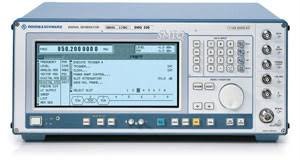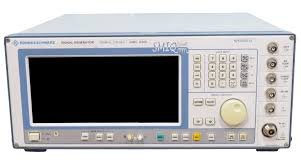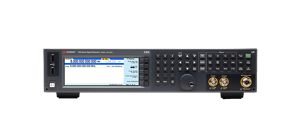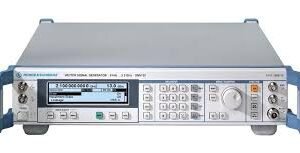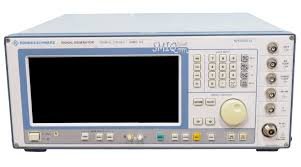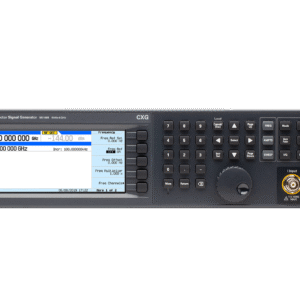
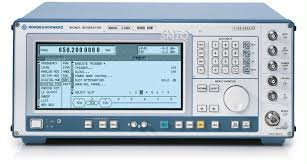

The Rohde & Schwarz SMIQ02 is a vector signal generator operating from 300 kHz to 2.2 GHz, engineered to produce complex modulated signals for communication and test applications across research, development, and production environments. It delivers exceptional phase noise performance, flexible modulation architecture, and rapid frequency/level settling to support current and emerging digital mobile radio standards.
Technical Specifications
Frequency Performance
• Frequency range: 300 kHz to 2.2 GHz
• Frequency resolution: 0.1 Hz
• Frequency setting time: <3 ms
• Fast restore mode: <500 µs
• List mode trigger response: <800 µs
Output Level
• Power range: −140 dBm to +13 dBm
• Level resolution: 0.1 dB
• Level setting time: <2.5 ms
• Maximum DC voltage: 35 V
Phase Noise & Spectral Purity
• SSB phase noise: −126 dBc/Hz typical at 1 GHz, 20 kHz offset
• Spectral purity: −130 dBc typical at 1 GHz, 20 kHz carrier offset
• Broadband noise (CW): −136 to −138 dBc typical across operating range
• Broadband noise (vector modulation): −136 to −137 dBc typical across operating range
Modulation Capabilities
• Standard: AM, Pulse, IQ
• Optional: FM/Phase, Digital
• Digital symbol rate: Up to 7 Msymbol/s
• Supported schemes: FSK, GFSK, GMSK, BPSK, QPSK, 8PSK, π/4DQPSK, 16QAM, 32QAM, 64QAM, 256QAM
• Mobile radio standards (with optional coder): CDMA, GSM, NADC, PCS 1900, PHS, PDC
Reference Oscillator
• Internal reference: 10 MHz, 8 dBm output, 50 Ω impedance
• External reference input: 1 MHz to 16 MHz (1 MHz steps), 0.1 V to 2 V rms, 200 Ω impedance
• OCXO option aging: <1×10⁻⁹/day (after 30 days)
• OCXO temperature stability: <5×10⁻⁸ (0°C to 50°C)
– Key Features
• High-resolution frequency tuning with 0.1 Hz steps
• Sub-millisecond frequency switching for dynamic test sequences
• Wide dynamic range spanning 153 dB
• Low phase noise across full frequency range
• Extensive digital modulation format library
– Typical Applications
• Mobile communication transceiver validation
• Receiver sensitivity and selectivity testing
• Adjacent-channel power measurement
• Digital modulation standard compliance verification
• Signal integrity assessment in development labs
– Compatibility & Integration
The instrument accepts external reference signals from 1 MHz to 16 MHz with frequency drift tolerance of 3×10⁻⁶, enabling synchronization with external standards. An optional OCXO provides superior frequency stability for demanding metrology applications.