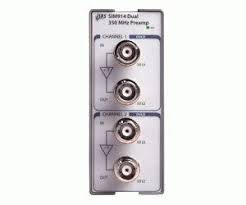

The Stanford Research SIM914 is a dual-channel, DC-coupled preamplifier delivering 5× voltage gain (14 dB) per channel across a DC to 350 MHz bandwidth. Engineered for precision amplification of weak signals from photodiodes, photomultiplier tubes, and similar detectors, the SIM914 achieves 6.4 nV/√Hz input noise with excellent phase linearity and fast signal integrity. Each channel operates independently with 50 Ω input and output impedance, ±200 mV input range, and ±1 V output range. Rise and fall times are 1 ns (bandwidth limited), with 2.7 ns propagation delay and 3 ns overload recovery for 10× overdrive. The module integrates into the SIM900 Mainframe via DB15/M connector or operates standalone with external +5 V DC power.
Technical Specifications
• Bandwidth: DC to 350 MHz
• Voltage Gain: 5 per channel (14 dB); cascadable to 25× (28 dB) across two modules
• Input Noise: 6.4 nV/√Hz typical; 80 µVrms broadband (1 Hz to 300 MHz)
• Input Impedance: 50 Ω, DC coupled
• Output Impedance: 50 Ω, DC coupled
• Input Operating Range: ±200 mV; DC limit ±4 V
• Output Operating Range: ±1 V with ±1.6 V clamp voltage
• Rise/Fall Time: 1 ns; 1.3 ns into 50 Ω load
• Propagation Delay: 2.7 ns typical
• Overload Recovery: 3 ns for 10× overdrive
• Input Protection: ±50 V transients (<1 µs)
• Crosstalk: −60 dB
• Channels: 2 independent
– Key Features
• Excellent phase linearity across entire frequency range
• Output overload detection threshold at ±1.3 V
• Peak-to-peak noise typically 5× rms value (~10 mVpp output, dual cascaded)
• Fast transient recovery with minimal distortion
– Interfaces
• Front panel: 4× BNC connectors (2 inputs, 2 outputs)
• Rear panel: DB15/M SIM interface connector for power and overload monitoring
– Compatibility & Integration
The SIM914 integrates directly into the Stanford Research Systems SIM900 Mainframe or operates standalone with external +5 V DC power supply.