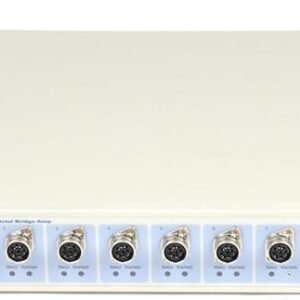

The Stanford Research SR640 is a dual-channel low-pass filter engineered for precision signal conditioning and noise rejection in demanding measurement environments. Each channel combines an 8-pole, 6-zero elliptic design with independent low-noise preamplification and output stages, delivering 115 dB/octave rolloff and 80 dB typical stopband attenuation. Cutoff frequencies span 1 Hz to 100 kHz with 3-digit resolution, making the SR640 suitable for anti-aliasing, audio analysis, and general frequency-domain applications requiring tight phase coherence between channels.
Technical Specifications
• Filter topology: 8-pole, 6-zero elliptic
• Rolloff: 115 dB per octave
• Passband ripple: 0.1 dB (typical)
• Stopband attenuation: 80 dB (typical)
• Cutoff frequency range: 1 Hz to 100 kHz (3-digit resolution)
• Input impedance: 1 MΩ (floating, differential)
• Input noise: 6 nV/√Hz
• Preamplifier gain: 0 to 60 dB (10 dB increments)
• Output amplifier gain: 0 dB, 10 dB, 20 dB
• Full-scale output: 10 Vpp into >300 Ω (standard); Option 01 provides 10 Vpp into 50 Ω
• Harmonic distortion: <–80 dB below full scale at 100 Hz (<1 Vpp); <–50 dB below full scale at 1 kHz
• Spurious components: <–80 dB below full scale (input source <50 Ω)
• Channel crosstalk: <–110 dB below full scale (input source <50 Ω)
• Phase match: ±0.75° (DC to fc, typical); ±0.25° for fc <10 kHz
– Key Features
• Independent dual channels with selectable AC/DC input coupling
• 180° phase invert capability per channel
• Adjustable DC offset nulling
• Analog ground available at rear-panel BNC for each channel
• Non-volatile memory: stores up to nine complete configurations
• GPIB and RS-232 interfaces with full programmability
– Typical Applications
Anti-aliasing filtration, audio signal analysis, sensor signal conditioning, and high-resolution frequency-domain measurements requiring low harmonic distortion and phase coherence.
– Compatibility & Integration
The SR640 is part of the SR600 series, which includes the SR645 (dual high-pass) and SR650 (high-pass/low-pass) models for flexible multi-filter configurations.