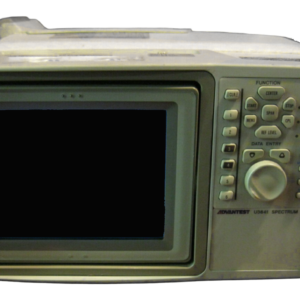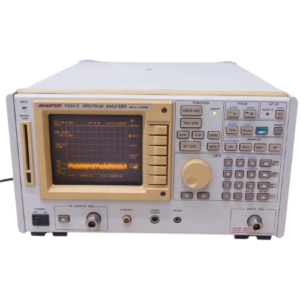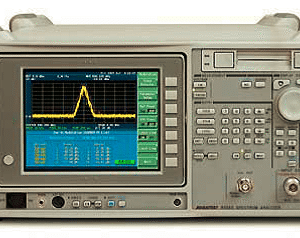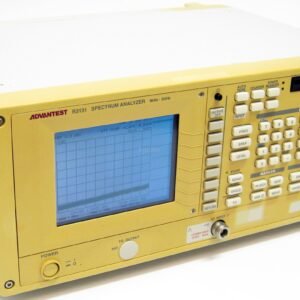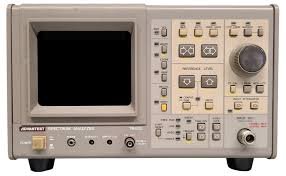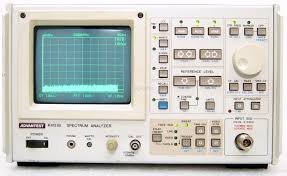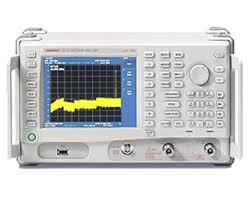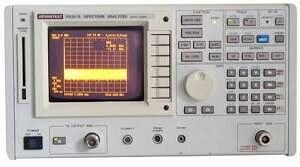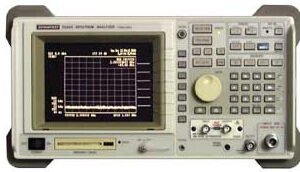

The Stanford Research Systems SR780 is a dual-channel FFT signal analyzer delivering real-time spectral and transfer function analysis up to 102.4 kHz per channel. Built for vibration analysis, noise measurement, acoustics, mechanical testing, and general spectrum analysis, the SR780 combines a 90 dB dynamic range with integrated signal generation and dual-channel architecture for comparative measurements and system characterization.
Technical Specifications
Acquisition and Processing
• 2 independent input channels with AC/DC coupling
• Input impedance: 1 MΩ || 20 pF (nominal)
• Input voltage range: ±10 V peak, ±3.54 Vrms full scale
• 16-bit ADC resolution; selectable sampling to 256 kS/s per channel
• FFT lengths: 1024, 2048, 4096, or 8192 points
• Resolution bandwidth selectable from 0.01 Hz to 25.6 kHz in 1-2-5 sequence
• Window functions: Hanning, Flat Top, Blackman-Harris, Uniform
• Averaging modes: Linear, Exponential, RMS, Peak Hold, Negative Peak Hold (1–1000 averages or continuous)
Measurement Capabilities
• Spectrum magnitude and Power Spectral Density (PSD)
• Transfer function analysis: magnitude, phase, coherence
• Cross-spectrum and cross-correlation analysis
• Auto-correlation and impulse response characterization
• Harmonic distortion: THD and THD+N measurements
• Octave analysis: 1/1, 1/3, 1/6, 1/12, 1/24 octave bands
• Time-domain waveform capture and transient analysis
– Key Features
• Real-time processing with 90 dB dynamic range across dual channels
• Integrated signal sources: White Noise, Sine, Chirp, Dual-Tone Chirp (DC to 102.4 kHz)
• 50 Ω nominal output impedance
• Multiple triggering modes: External, Line, Amplitude, Window
• Internal memory for trace storage, configurations, and time-domain data
– Typical Applications
• Vibration and shock characterization
• Acoustic and noise analysis
• Mechanical and structural testing
• System identification and transfer function measurement
• Harmonic and distortion analysis
• Quality assurance and failure analysis
– Compatibility & Integration
• IEEE-488 (GPIB) for remote control and automated data transfer
• RS-232 serial interface for instrument control and data logging
• Centronics parallel port for printer output
• Analog monitor outputs for real-time signal access
• External trigger and reference clock I/O for system synchronization