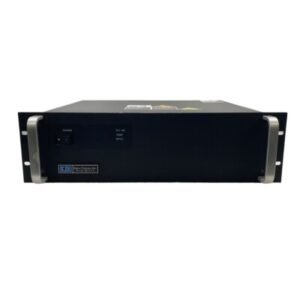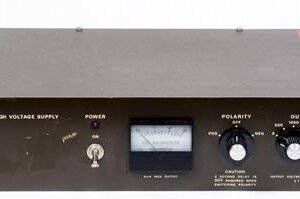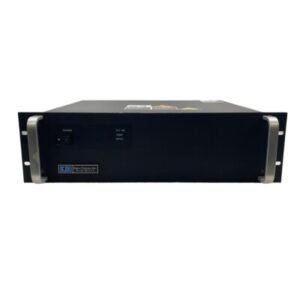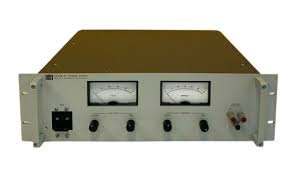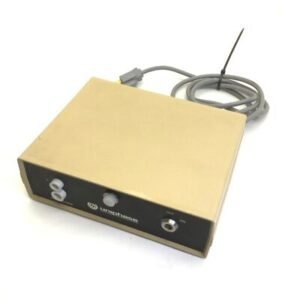

The Stanford Research Systems PS310 is a microprocessor-controlled switching high-voltage DC power supply engineered for precision laboratory and test applications requiring stable, adjustable output with exceptional low-noise performance. This instrument delivers output voltage from ±12 VDC to ±1.25 kVDC at up to 20 mA with 25 W maximum power, achieving 0.001% line regulation and 0.005% load regulation across its operating range.
Technical Specifications
Output performance is characterized by output ripple below 0.0015% of full scale (typical) and voltage accuracy of 0.05% with 1 V resolution. Current measurement provides ±1 µA resolution with ±1 µA typical display accuracy. Temperature drift remains 50 ppm/°C from 10 to 40 °C. The supply operates from 100–240 VAC, 50–60 Hz input and consumes 75 W.
Protection architecture includes arc and short-circuit detection with programmable voltage, current, and current-trip limits. Trip response time is less than 10 ms (excluding stored charge), with 12 ms typical recovery for 40% load-step changes. Output discharge reaches <1% of full-scale voltage in under 6 s with no load.
– Key Features
• Programmable voltage limit: 0 to 100% of full scale
• Programmable current limit and trip: 10 µA to 105% of full scale
• Nine-position instrument configuration memory
• Front-panel three-position high-voltage enable switch
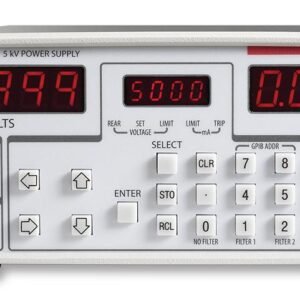
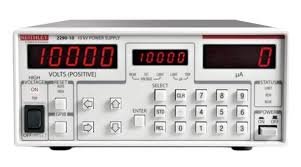
• LED displays for real-time voltage and current monitoring
• Analog input (0–10 VDC) for external voltage programming
• Two analog outputs (10 mA drive, 1 Ω impedance) for monitoring
• SHV male connector for high-voltage output
– Interfaces and Integration
RS-232 interface comes standard. GPIB communication is available as Option 01. Rear-panel analog inputs and outputs enable external control and monitoring integration. The 3.5 in × 8.1 in × 14.0 in form factor (8 lbs) fits standard benchtop and rack-mount configurations.