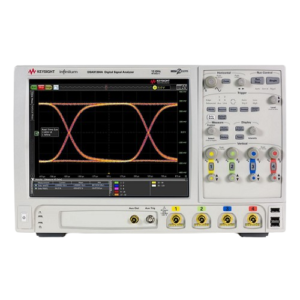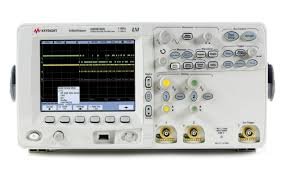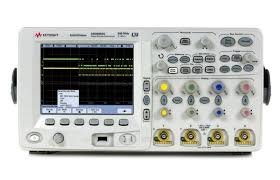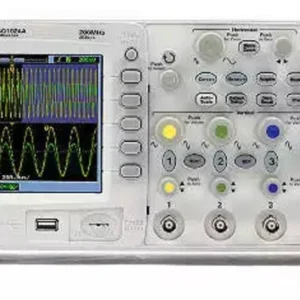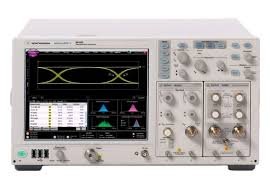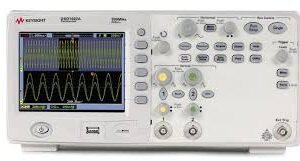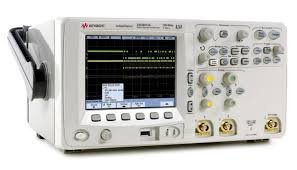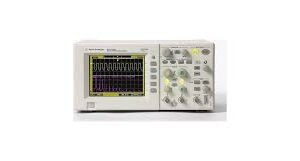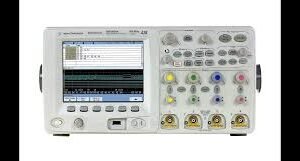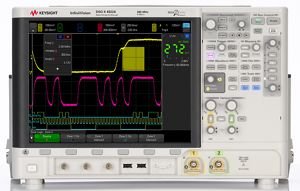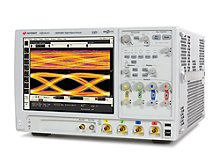

The Tektronix 2230 is a 100 MHz digital storage oscilloscope purpose-built for signal analysis, waveform capture, and electronic system validation. This dual-channel instrument combines real-time and equivalent-time sampling with non-volatile waveform storage, enabling engineers to acquire, document, and analyze transient events and repetitive signals in laboratory and field settings.
Technical Specifications
Acquisition & Sampling
• Bandwidth: 100 MHz
• Sampling rate: Up to 10 MS/s (equivalent time mode); 1 MS/s (real-time mode)
• Record length: 1K points per channel
• Waveform storage: Up to 10 waveforms in non-volatile memory
Vertical System
• Channels: 2
• Sensitivity: 2 mV/div to 5 V/div
• Vertical accuracy: ±3%
• Input coupling: AC, DC, GND
• Input impedance: 1 MΩ ±2% || 20 pF ±3 pF
• Maximum input voltage: 400 V peak-to-peak (CAT II); derate at 10 V/MHz above 10 MHz
Horizontal System
• Time base range: 50 ns/div to 5 s/div
• Sweep speed: 1 ns/div (equivalent time mode)
• Pre-trigger view and variable post-trigger delay
Trigger System
• Modes: Auto, Normal, Single Sequence
• Sources: CH1, CH2, EXT, EXT/10, Line
• Coupling options: AC, DC, LF Reject, HF Reject
• Variable holdoff control
– Key Features
• 8×10 division CRT display with P1 phosphor and internal non-parallax graticule
• Waveform processing: voltage/time cursors, averaging, roll mode
• Probe compensation output: ~1 kHz square wave
• External trigger input via BNC connector
– Power & Physical
• Supply: 100–120 VAC, 115 VAC, or 220–240 VAC ±10%, 48–66 Hz
• Power consumption: Approximately 50 W
• Dimensions: 34.3 cm (W) × 15.5 cm (H) × 42.0 cm (D)
• Weight: Approximately 9.1 kg
– Typical Applications
Troubleshooting analog and digital circuits, validating signal integrity, capturing single-shot and repetitive waveforms, and performing time-domain analysis across communications, power electronics, and general instrumentation.
– Compatibility & Integration
Standard BNC connectors for channel inputs and external trigger; compatible with 1 MΩ passive probes and 10× probe attenuation factors.